
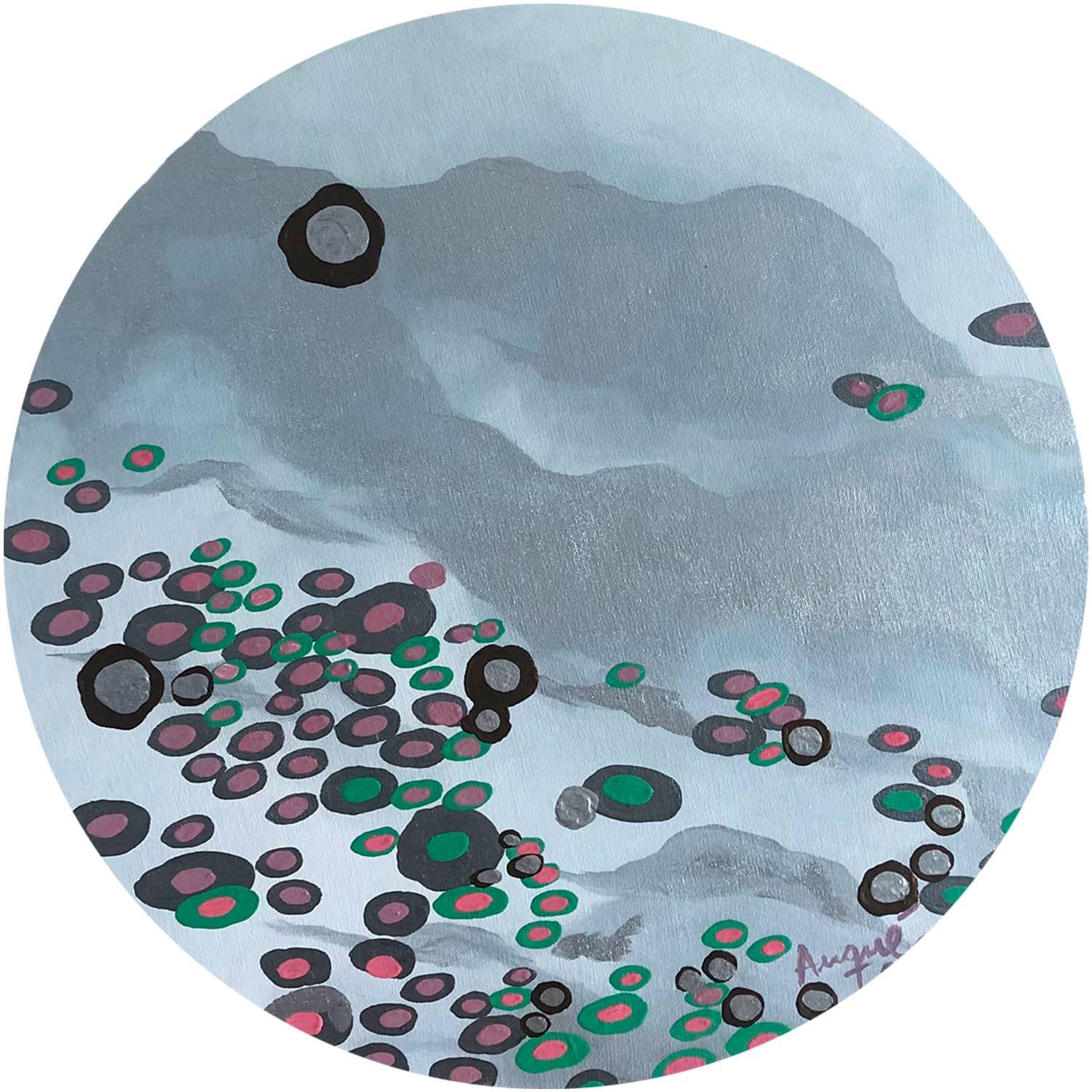
A reflective space where connection unfolds quietly, allowing shared identity and memory to exist in continuous dialogue.
Trilogy Silver
Year: 2022
Medium: Acrylic on canvas
Diameter: 60 cm
Private collection in Colombia
Trilogy Silver – An Ode to Sisterhood and Shared Identity
“Trilogy Silver” emerges as an intimate and reflective work within Rosana Auqué’s practice, where personal narrative becomes a universal language. At its core, the piece is a tribute to the bond between three sisters—an emotional structure translated into form, rhythm, and material presence.
The use of silver is not incidental. It introduces a quieter luminosity compared to gold or bronze, suggesting reflection rather than proclamation. Silver carries a sense of memory, of something that does not seek to dominate but to endure. In this work, it becomes a medium through which relationships are not only represented but felt—subtle, constant, and deeply rooted.
Rather than depicting figures, the composition unfolds through interaction. Forms appear in dialogue, coexisting without hierarchy, echoing the way familial bonds operate: distinct yet inseparable. The painting does not narrate a story in a linear way; instead, it holds a shared space where identity is collective as much as individual.
The Meaning Behind Trilogy Silver
“Trilogy Silver” can be understood as a visual meditation on belonging. The number three is not treated symbolically in an abstract sense, but as a lived structure—three lives intertwined, shaping and reflecting one another over time.
There is no tension in the composition, no rupture. Instead, there is continuity. The elements move together, suggesting that connection is not something constructed but something inherent. The painting becomes an ode—not in a celebratory or grandiose sense, but in a quiet acknowledgment of presence, history, and shared experience.
Silver reinforces this idea. It mirrors, it absorbs, it responds. It does not impose meaning but allows meaning to emerge through relationship.
Material and Presence
The materiality of “Trilogy Silver” plays a fundamental role in its perception. Silver interacts with light in a way that changes depending on the viewer’s position and the surrounding environment. This shifting quality introduces a temporal dimension to the work—what is seen is never fixed.
This aligns with the concept behind the piece: relationships are not static. They evolve, adapt, and transform, yet remain grounded in a shared origin.
The surface of the painting invites contemplation rather than immediate interpretation. It is not about decoding, but about experiencing.
A Personal Work with Universal Resonance
While rooted in a deeply personal story, “Trilogy Silver” extends beyond biography. It speaks to anyone who has experienced connection as something that defines, supports, and transforms.
The absence of explicit representation allows the viewer to enter the work without restriction. It becomes a space where personal memories, relationships, and emotions can be projected and recognized.
In this sense, the painting operates both as a tribute and as an open field—one that holds meaning without closing it.
Frequently Asked Questions about “Trilogy Silver”
What does “Trilogy Silver” represent?
“Trilogy Silver” represents the relationship between three sisters. It is conceived as an ode to their bond, translating a personal connection into a visual and emotional experience.
Why is silver used in this artwork?
Silver introduces a reflective and subtle luminosity. Unlike more dominant materials, it suggests memory, continuity, and quiet presence, aligning with the emotional tone of the piece.
Is the work figurative or abstract?
The work is abstract. It does not depict figures directly but conveys relationships through form, movement, and interaction.
What is the main concept behind the trilogy?
The trilogy is based on the idea of connection between three individuals. It explores identity as something shared and interdependent rather than isolated.
How should the viewer approach this painting?
The painting is not meant to be interpreted in a fixed way. It invites a contemplative experience, where meaning emerges through perception, memory, and personal reflection.