Popped Balloon 11
Artist: Rosana Auqué
Year: 2024
Medium: Oil on canvas
Dimensions: 8 x 8 inches
Price: USD $700
Inquiry
Popped Balloon 11 – When Fragility Becomes Form
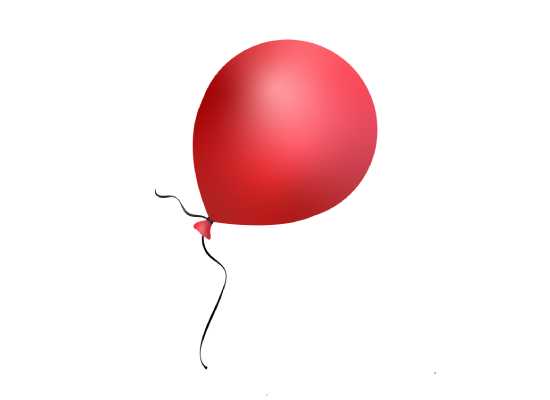
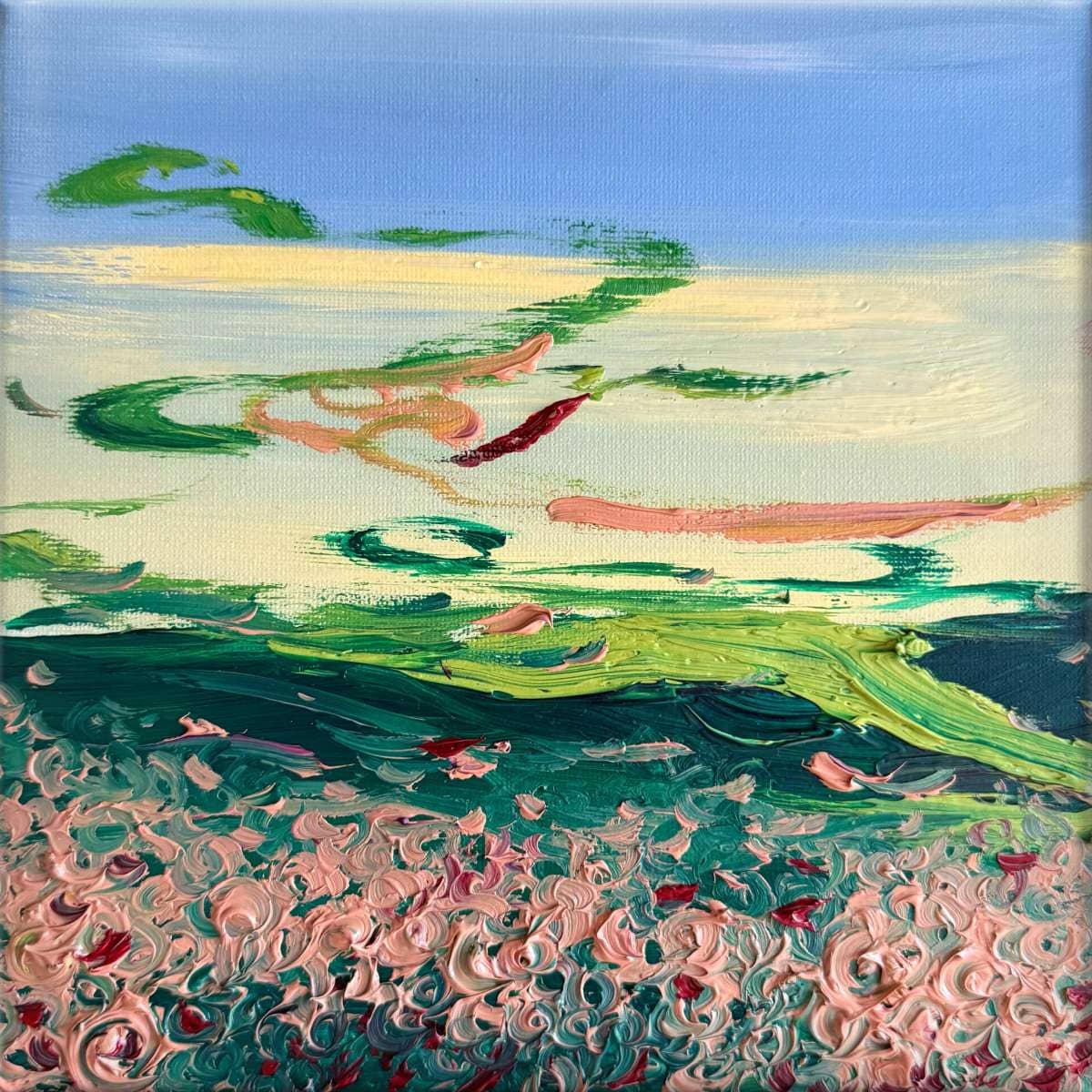
“Popped Balloon 11” is part of a larger body of work within the Airs of Freedom collection, where the idea of rupture is not an end, but a transformation. In this piece, the moment a balloon bursts is reimagined as a quiet unfolding—an expansion into something organic, almost floral. What once held air now opens into space, color, and possibility.
Painted in oil on canvas in 2024, this small-format work (8 x 8 inches) carries an intimate intensity. Its scale invites proximity, asking the viewer not to observe from a distance but to enter into a subtle, almost meditative dialogue with the painting.
From Rupture to Bloom
There is a paradox at the heart of “Popped Balloon 11.” The act of bursting—typically associated with loss, interruption, or disappearance—is here transformed into emergence. The fragmented shape of the balloon does not collapse; it expands into forms that resemble petals, gestures, or traces of movement.
This transformation reflects a recurring exploration in Rosana Auqué’s work: the idea that what appears to break may, in fact, be opening. The painting does not dramatize the rupture. Instead, it softens it, translating it into rhythm and harmony.
Color plays a central role in this process. Rather than depicting a literal explosion, the palette suggests continuity. The tones seem to flow into each other, dissolving boundaries between inside and outside, structure and release.
A Language of Small Formats
As part of a series of 28 works, “Popped Balloon 11” belongs to a constellation of variations. Each piece explores the same conceptual gesture, yet none repeats the other. The small format becomes a space for precision—where each mark matters, and each variation carries its own emotional register.
Unlike larger canvases that often evoke immersion through scale, these works invite attention through detail. They are not about spectacle but about presence. The viewer is drawn closer, not just physically, but perceptually.
The Poetics of Air and Transformation
Air, in Rosana Auqué’s practice, is never empty. It is a medium of connection, movement, and invisible forces. In earlier works, balloons often symbolize lightness, elevation, or collective energy. In “Popped Balloon 11,” that same symbol undergoes a shift.
Here, air is no longer contained—it disperses. Yet this dispersion is not chaotic. It becomes structured through color and gesture, suggesting that even in dissolution, there is form. The painting proposes a quiet continuity between holding and releasing, between tension and expansion.
A Moment Suspended
What the viewer encounters is not the instant of rupture itself, but its aftermath—a suspended moment where transformation has already begun. This temporal ambiguity gives the work its contemplative quality. It exists somewhere between before and after, between object and trace.
There is no narrative imposed. Instead, the painting offers a space where meaning can emerge through perception.
Frequently Asked Questions about “Popped Balloon 11”
What is the meaning behind “Popped Balloon 11”?
The painting explores transformation through rupture. The burst balloon becomes a metaphor for change—where what breaks does not disappear, but evolves into new forms.
What materials and technique are used in this artwork?
“Popped Balloon 11” is created using oil on canvas. The medium allows for depth, blending, and subtle transitions in color and texture.
Why is this artwork part of a series?
The piece belongs to a series of 28 works that explore variations of the same conceptual moment: the transformation of a balloon after it bursts. Each work presents a unique interpretation.
How does this work relate to the Airs of Freedom collection?
Within the Airs of Freedom collection, the balloon is a recurring symbol of lightness and movement. In this work, that symbol evolves, emphasizing transformation rather than elevation.
What makes this artwork significant within Rosana Auqué’s practice?
It represents a shift in perspective—moving from representation of form to exploration of transformation. It condenses a broader conceptual inquiry into an intimate scale.