
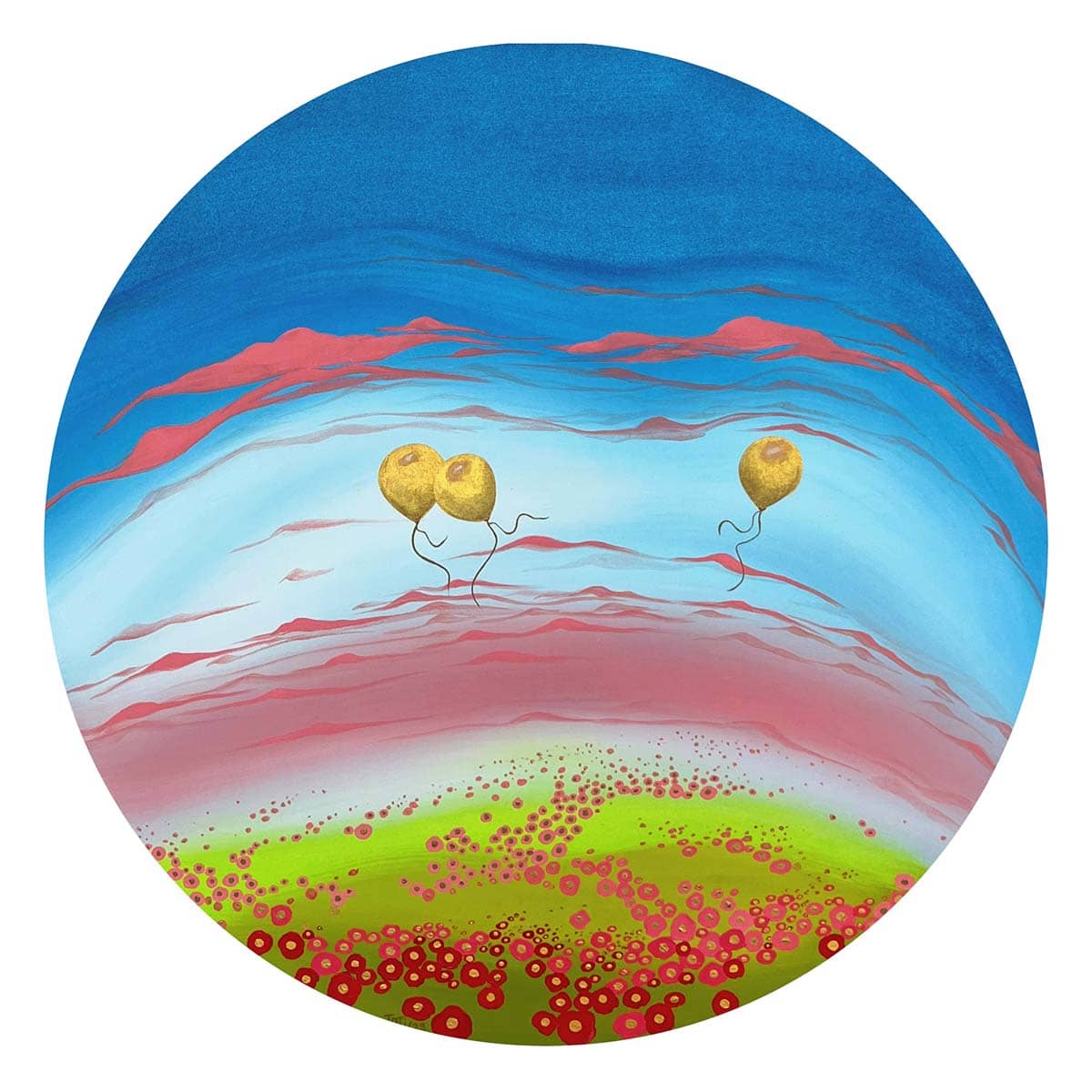
Las Tres Gracias is a 2023 circular acrylic painting by Rosana Auqué that reflects on beauty, goodness, and truth through three golden balloons suspended in a luminous field of balance and contemplation.
Las Tres Gracias
Artist: Rosana Auqué
Year: 2023
Medium: Acrylic on canvas
Diameter: 110 cm
Price: USD $7.500
Inquiry
Las Tres Gracias – A Contemporary Reflection on Beauty, Goodness, and Truth
“Las Tres Gracias” by Rosana Auqué is a contemplative exploration of one of the oldest philosophical ideals: the inseparable unity of beauty, goodness, and truth. Inspired by classical thought—particularly the vision of harmony found in Plato’s philosophy—this work reinterprets these timeless concepts through a contemporary visual language that is both light and expansive.
Created in 2023, this circular painting (110 cm diameter) presents three golden balloons floating within an open, luminous space. Each form represents one of the three pillars, yet none exists in isolation. Their presence is relational, not individual. They coexist, overlap, and respond to one another, forming a subtle but powerful visual dialogue.
Rather than illustrating these ideas in a literal or figurative way, the work invites the viewer into a state of reflection. It proposes that beauty is not merely aesthetic, that truth is not purely intellectual, and that goodness is not confined to action. Instead, these three forces are presented as interdependent energies that shape human experience from within.
A Visual Language Beyond Representation
The Symbolism of the Golden Balloons
The use of golden balloons is not accidental. Gold, throughout history, has been associated with the sacred, the incorruptible, and the eternal. In this work, it becomes a material that transcends decoration and enters the realm of meaning.
Each balloon carries a quiet luminosity, reflecting light rather than containing it. This creates a sense of movement and immateriality, as if these forms are not bound to the physical world but exist somewhere between presence and disappearance.
The balloon itself, often associated with celebration or fragility, becomes a paradox. It suggests both elevation and impermanence. In “Las Tres Gracias,” this duality reinforces the idea that beauty, goodness, and truth are not static ideals, but living forces that must be continually sustained.
The Circular Format as a Conceptual Space
The circular canvas plays a crucial role in the structure of the work. Without edges or hierarchy, it removes any notion of beginning or end. This format reflects the philosophical idea that the three concepts it represents are infinite and cyclical.
There is no central figure, no dominant element. Instead, the composition is balanced through presence and tension. The eye moves continuously, guided not by narrative but by relationship.
Beauty as a Transformative Experience
At the heart of “Las Tres Gracias” lies a deeper question: what does it mean to experience beauty?
Here, beauty is not reduced to visual pleasure. It is presented as something that has the capacity to transform the individual. It is something that nurtures, elevates, and connects. It exists beyond the surface and invites introspection.
In this sense, the work moves away from decorative aesthetics and enters a more contemplative territory. It suggests that to encounter beauty is also to encounter truth, and that both are inseparable from a sense of inner goodness.
This perspective aligns with a broader trajectory in Rosana Auqué’s practice, where light, space, and symbolic forms are used to explore states of being rather than external realities.
Artwork Details
Technical Information
Title: Las Tres Gracias
Artist: Rosana Auqué
Year: 2023
Medium: Acrylic on canvas
Dimensions: 110 cm diameter
Price: USD $7,500
Frequently Asked Questions about “Las Tres Gracias”
What does “Las Tres Gracias” represent in this artwork?
The painting represents the philosophical unity of beauty, goodness, and truth. Each concept is symbolized through a golden form, emphasizing their interdependence rather than their individuality.
Why are balloons used as symbols?
The balloons function as metaphors for elevation, lightness, and impermanence. They suggest that these values are not fixed, but dynamic and evolving within human experience.
Is this work inspired by classical philosophy?
Yes. The work draws from classical philosophical ideas, particularly the notion that beauty, truth, and goodness cannot exist independently, but form a unified whole.
What makes this artwork relevant today?
In a contemporary context often dominated by surface-level aesthetics, this work reintroduces a deeper understanding of beauty as something that nurtures the spirit and connects individuals to a broader sense of meaning.
Is “Las Tres Gracias” available for acquisition?
Yes, the artwork is available. For inquiries, collectors are encouraged to contact through the official website.