
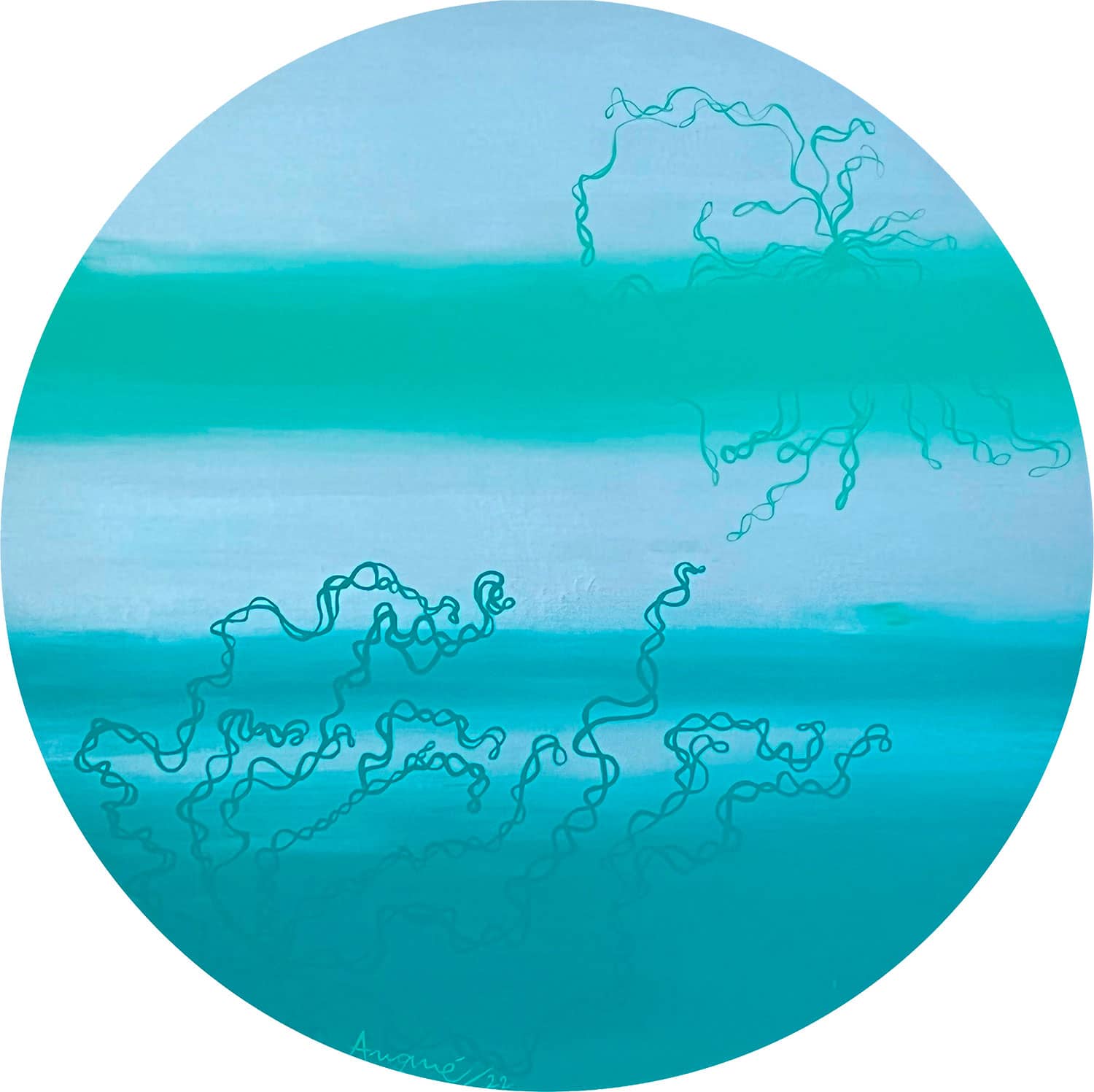
Mint is a 2022 circular acrylic painting by Rosana Auqué that evokes freshness, unity, and quiet emotional flow through gentle abstract movement and a contemplative sense of connection.
Mint – A Study of Connection and Continuity
“Mint” emerges from a moment of return. Painted in 2022, this circular work belongs to a body of pieces first presented in Santa Marta, a place that is not only geographic but deeply personal. The painting does not attempt to represent a landscape or a fixed scene. Instead, it unfolds as a field of movement—an atmosphere where forms dissolve into each other and reappear as part of a larger continuity.
The circular format becomes essential. There is no beginning and no end. The viewer is not invited to look at something, but to enter into a flow. Within this surface, soft tonal transitions and organic rhythms suggest an energy that moves without interruption, echoing the invisible threads that connect individuals, places, and moments in time.
The Language of Energy and Color
A Chromatic Field Without Borders
The palette in “Mint” operates beyond descriptive color. It is not about depicting mint as an object or reference, but about evoking a sensation—freshness, openness, a quiet expansion of perception. The tones seem to breathe, shifting subtly across the canvas, creating a visual rhythm that resists fixation.
There are no rigid lines, no imposed structures. Instead, the composition allows color to behave freely, forming soft intersections where one presence blends into another. This lack of boundaries reflects a deeper intention: to dissolve separation and suggest unity.
Movement as a Visual Experience
Rather than guiding the viewer through a narrative, the painting invites a different kind of attention. The eye moves continuously, never settling in one place. This movement mirrors the idea that life itself is not static—it is an ongoing process of connection, transformation, and return.
The Connection Collection and Santa Marta
“Mint” is part of the Connection collection, first presented in Santa Marta, the artist’s hometown. This context is not incidental. The works created during this period are rooted in a reflection on interconnectedness—not as an abstract concept, but as a lived experience.
In Santa Marta, the proximity to nature, the sea, and the cultural memory of place converge. The paintings developed there carry a sense of continuity between the individual and the collective, between the internal and the external. In “Mint,” this translates into a visual language where everything seems to belong to the same field of existence.
The painting becomes a quiet affirmation: nothing exists in isolation. Every movement, every presence, is part of a larger system that we often perceive only intuitively.
Circular Form as Conceptual Structure
Beyond Composition
The choice of a circular canvas is not merely aesthetic. It is conceptual. The circle eliminates hierarchy—there is no top, no bottom, no central dominance. Every point holds equal importance.
This structure reinforces the idea of connection as something non-linear. Relationships are not arranged in order; they exist simultaneously, overlapping and coexisting within the same space.
A Space Without Edges
In “Mint,” the absence of edges becomes symbolic. The painting does not contain the experience—it extends beyond it. What is seen on the surface suggests something larger, something that continues outside the limits of the canvas.
A Contemplative Encounter
Standing in front of “Mint” is not about interpretation in the traditional sense. It is about presence. The work does not demand explanation; it invites awareness.
There is a calmness in its rhythm, but also a subtle intensity. The viewer may feel drawn into its surface, not to decode it, but to experience it. In this way, the painting functions less as an object and more as a space—one that holds attention without directing it.
Frequently Asked Questions about “Mint”
What is the meaning behind “Mint” by Rosana Auqué?
“Mint” explores the idea of connection as a continuous and invisible force. Through color, movement, and circular form, the painting reflects how all elements of life are interconnected within a shared field of existence.
Why is the canvas circular?
The circular format removes hierarchy and direction, reinforcing the concept of continuity. It allows the composition to exist without a beginning or end, aligning with the idea of infinite connection.
What collection does “Mint” belong to?
“Mint” is part of the Connection collection, first presented in Santa Marta. This body of work reflects on the relationships between individuals, environments, and the broader universe.
What technique is used in “Mint”?
The work is created using acrylic on canvas. The technique emphasizes fluid transitions, layered color, and soft movement rather than defined shapes.
How should a viewer approach this artwork?
Rather than seeking a fixed interpretation, the viewer is invited to experience the painting intuitively. “Mint” is meant to be observed as a space of presence, where perception unfolds naturally over time.