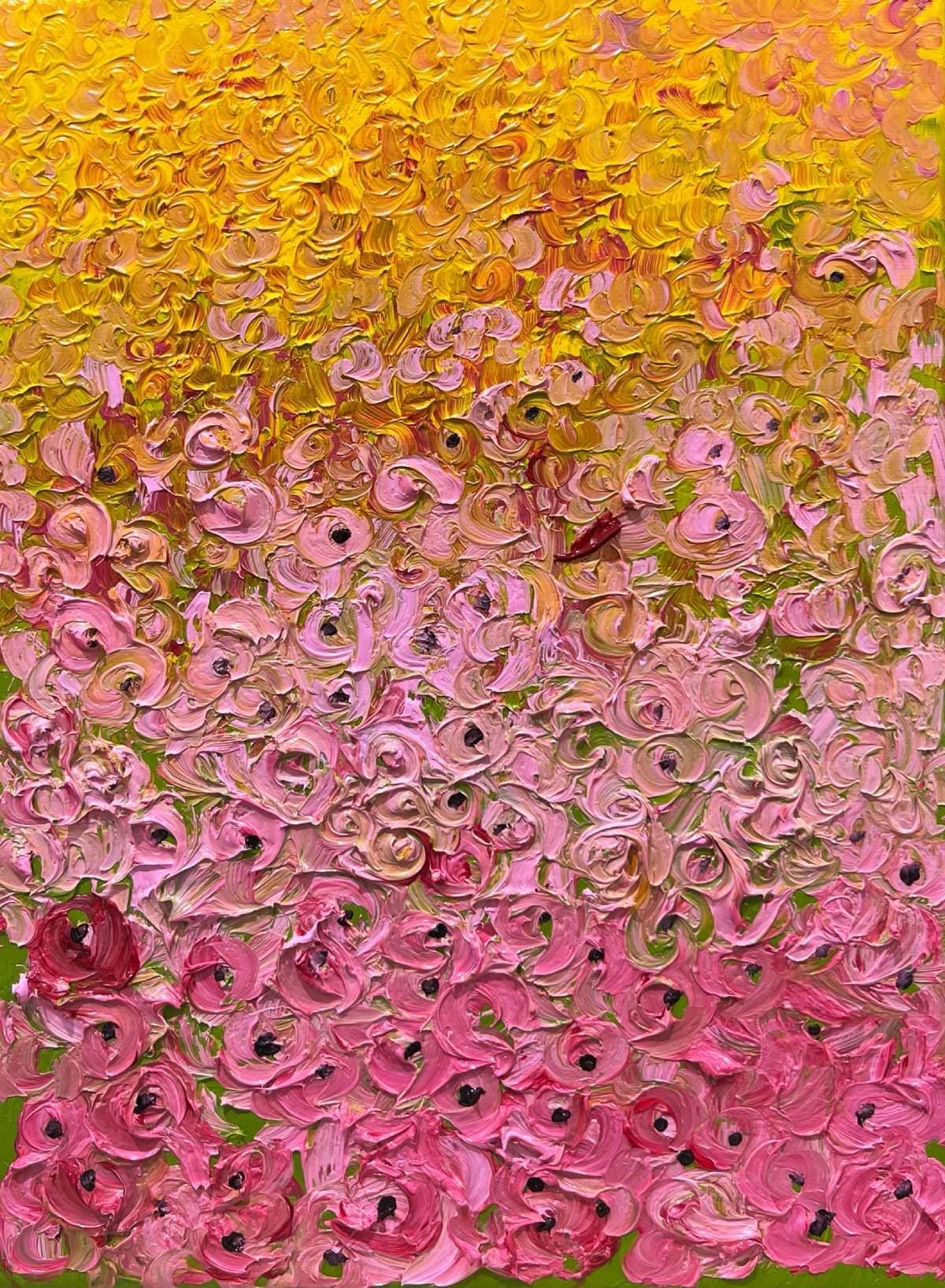
Landscape 1 by Rosana Auqué, an intimate 2024 oil on canvas from the Landscapes Collection, where floral repetition and saturated color create an immersive abstract field of beauty.
Landscape 1
Artist: Rosana Auqué
Year: 2024
Medium: Oil on canvas
Dimensions: 9 x 12 inches
Price: USD $700
inquiry
Landscape 1 – A Field Without Silence
Landscape 1 is part of a body of work where the idea of landscape shifts away from horizon, depth, or perspective, and instead becomes an immersive surface. In this painting, there is no distance to observe—only presence. The entire canvas is occupied, filled without interruption, as if the space itself refused emptiness.
Painted in oil on canvas, the work explores what happens when beauty is not framed, but expanded. Flowers do not appear as individual elements; they accumulate, overlap, and dissolve into one another. The composition resists hierarchy. There is no central focus, no dominant figure. Everything exists at the same level of intensity.
This absence of visual hierarchy transforms the act of looking. The viewer is not guided but absorbed. The eye moves continuously, without rest, navigating a field that feels both abundant and contained.
The Language of Saturation and Repetition
When the Canvas Becomes a Continuous Surface
In Landscape 1, repetition is not decorative—it is structural. The gesture of filling the entire surface with floral forms creates a sense of insistence, almost a quiet urgency. There is no background. There is no pause. Every part of the painting participates equally.
This approach challenges traditional landscape painting, where space is often defined by distance or emptiness. Here, space is defined by accumulation. The landscape is not something we look at; it is something we enter visually.
Color as a System of Relationships
The palette operates within close tonalities, allowing subtle variations to emerge through proximity rather than contrast. Instead of sharp oppositions, the painting builds a harmony of related colors, where differences are perceived gradually.
This creates a visual rhythm that is both calm and intense. The viewer is drawn into a slow process of recognition—seeing not through contrast, but through nuance.
An Exercise in Creating Beauty
At its core, Landscape 1 can be understood as an exercise in the pursuit of beauty—not as decoration, but as intention. The act of overfilling the canvas becomes a way of exploring how much beauty can be sustained within a single surface.
There is a tension between control and excess. The composition is carefully constructed, yet it appears almost overflowing. This balance gives the work its emotional resonance: it feels generous, expansive, and at the same time contained within its own limits.
Rather than representing a specific place, the painting proposes a condition—a space where beauty is continuous, uninterrupted, and fully present.
Artwork Details
Title: Landscape 1
Artist: Rosana Auqué
Year: 2024
Medium: Oil on canvas
Dimensions: 9 × 12 inches
Price: $700 USD
Availability: Available
Frequently Asked Questions about “Landscape 1”
What is the concept behind Landscape 1?
Landscape 1 explores the idea of a landscape without emptiness. Instead of using depth or perspective, the painting creates space through accumulation, filling the entire canvas with floral forms.
Why are there no empty spaces in the composition?
The absence of empty space is intentional. It reflects an interest in creating a continuous visual field where beauty is sustained across the entire surface, without interruption.
How should the viewer approach this painting?
The work is not meant to be observed from a single focal point. It invites a slow, immersive gaze, where the eye moves freely across the surface without hierarchy.
What makes this piece different from traditional landscapes?
Unlike traditional landscapes that rely on horizon and depth, Landscape 1 removes distance entirely. The viewer is not looking into the scene but encountering it directly.
Is this painting part of a series?
Yes, it belongs to a group of landscapes conceived in pairs, where each work explores variations of fullness, color relationships, and spatial saturation.