
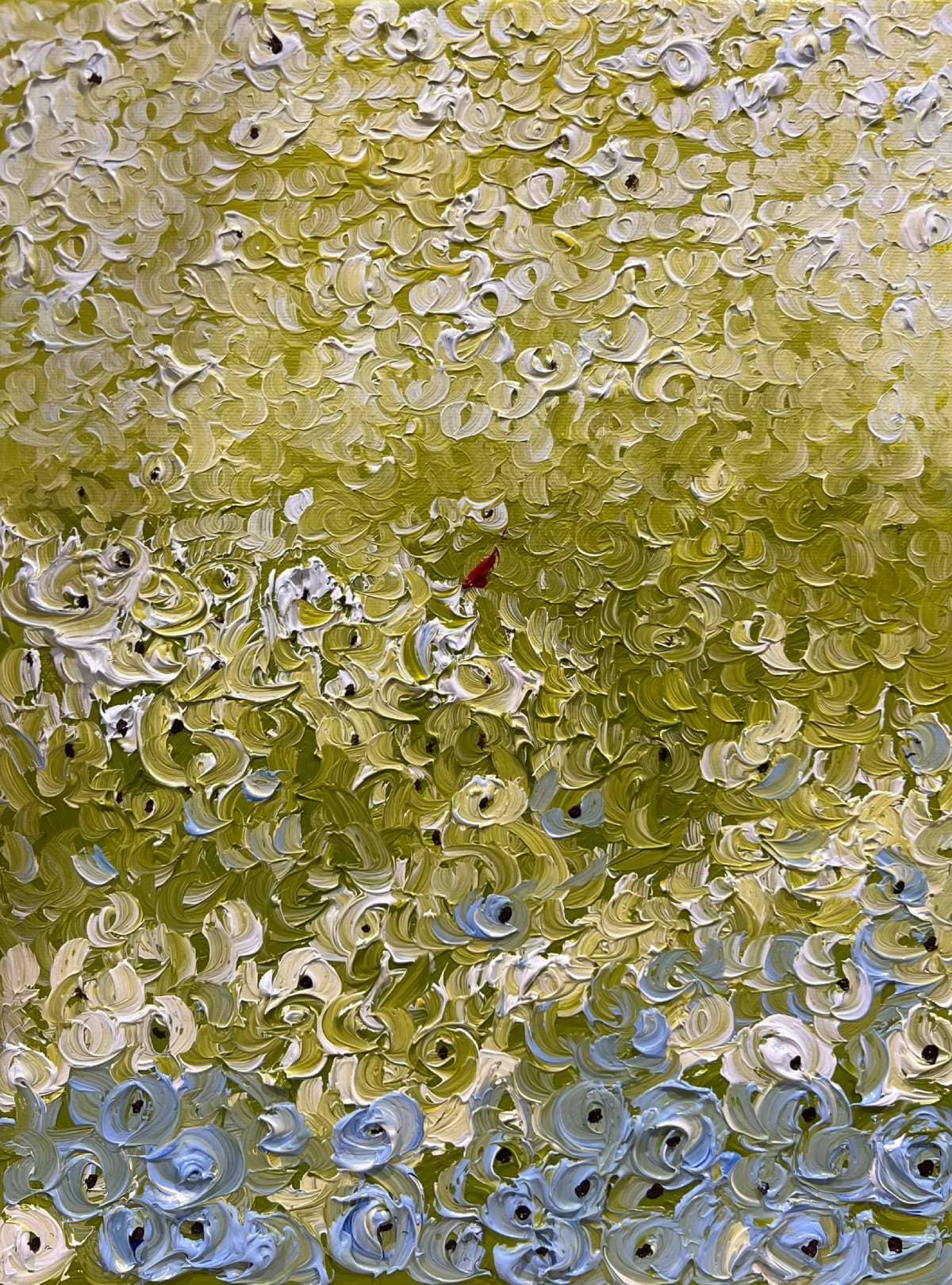
Landscape 5 by Rosana Auqué, a 2024 oil on canvas from the Landscapes Collection, where dense floral repetition, tonal harmony, and visible painterly gesture create an immersive abstract landscape of color and abundance.
Landscape 5
Artist: Rosana Auqué
Year: 2024
Medium: Oil on canvas
Dimensions: 9 x 12 inches
Private collection in Italy.
Landscape 5 – A Saturated Field of Beauty and Color
“Landscape 5” by Rosana Auqué is part of a series of paired landscapes where the traditional idea of space is intentionally transformed. In this work, the canvas becomes a dense and immersive field, completely filled with flowers, leaving no visual pause or emptiness. The absence of negative space is not accidental—it is a deliberate gesture toward abundance, intensity, and the experience of being surrounded by beauty without escape.
Painted in oil on canvas (9 x 12 inches, 2024), this piece explores the limits of visual saturation. The surface is overcharged with floral elements that seem to expand beyond the boundaries of the frame. Rather than depicting a landscape as something distant or contemplative, the painting invites the viewer to enter into it, almost as if stepping into a living, breathing environment of color.
The Exploration of Tonality and Repetition
One of the defining aspects of “Landscape 5” is its focus on tonal harmony. Instead of relying on stark contrasts, the composition works within close color ranges, exploring subtle variations within the same tonal families. This creates a sense of cohesion while maintaining complexity.
Color as Structure
Color is not used here as decoration, but as structure. Each flower contributes to a larger visual rhythm, where repetition becomes a language. The eye moves across the canvas without interruption, guided by shifts in hue and intensity rather than by empty space or defined boundaries.
An Exercise in Visual Density
The painting can be understood as an exercise in visual density—an intentional effort to fill every part of the canvas. This approach challenges conventional composition rules, where balance is often achieved through contrast between filled and empty areas. Here, balance emerges from accumulation and continuity.
A Contemporary Interpretation of Landscape
“Landscape 5” redefines what a landscape can be. It is not a horizon, not a distant view, but a fully immersive surface. The viewer is not positioned outside looking in, but rather placed within the experience of the painting itself.
The Landscape as Emotional Space
Instead of representing a physical place, the work suggests an emotional or psychological space. The overwhelming presence of flowers can be read as a reflection on beauty, excess, and the human desire to create environments that are entirely filled with meaning.
Between Control and Overflow
There is a tension between control and spontaneity in the composition. While the repetition of forms suggests a structured approach, the accumulation creates a feeling of overflow, as if the image could continue expanding indefinitely.
H2: Materiality and Gesture
Executed in oil on canvas, the work retains a tactile quality that reinforces its intensity. The layering of paint contributes to the sensation of depth, even within a composition that resists traditional spatial perspective.
The Presence of the Hand
The gesture of the artist remains visible throughout the surface. Each element carries a sense of immediacy, reinforcing the idea that the painting is not just an image, but a process of continuous making.
Frequently Asked Questions about “Landscape 5”
What is the main concept behind “Landscape 5”?
The work explores the idea of filling the entire pictorial space with floral elements, eliminating empty areas to create a fully immersive visual experience centered on beauty and abundance.
Why are there no empty spaces in the painting?
The absence of empty space is intentional. It reflects an exploration of saturation and the desire to create a landscape that is entirely composed of color and form, without interruption.
How does “Landscape 5” differ from traditional landscapes?
Unlike traditional landscapes that depict depth and distance, this work flattens the space and brings everything to the surface, transforming the landscape into an immediate and immersive field.
What role does color play in this artwork?
Color functions as the main structural element. The painting explores variations within similar tonalities, creating harmony while maintaining visual richness.
Is “Landscape 5” part of a larger series?
Yes, it belongs to a series of landscapes conceived in pairs, where the exploration of density, color, and repetition is developed across multiple works.