
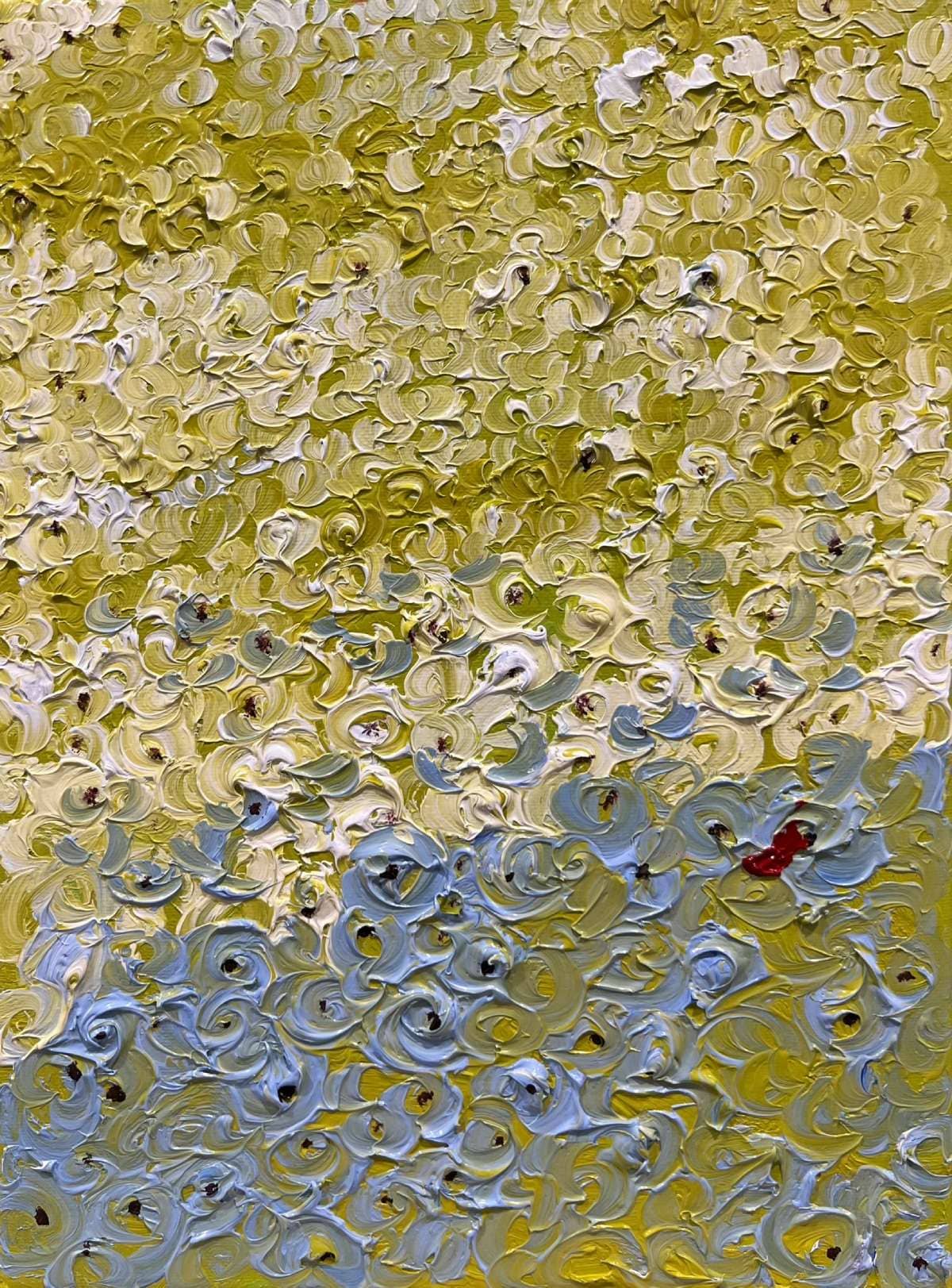
Landscape 6 by Rosana Auqué, a 2024 oil on canvas from the Landscapes Collection, where floral abundance, close tonal color, and continuous movement create an intimate abstract landscape of immersion and presence.
Landscape 6
Artist: Rosana Auqué
Year: 2024
Medium: Oil on canvas
Dimensions: 9 x 12 inches
Price: USD $700
Inquiry
Landscape 6 – A Study of Abundance and Color
Landscape 6 is part of a series of paired landscapes in which the canvas becomes a space of total immersion. Rather than suggesting nature through fragments or horizons, this work removes all emptiness. The entire surface is filled—intentionally saturated—with flowers, color, and movement. There is no background left untouched, no pause for the eye to rest. Everything is presence.
In this piece, the gesture is clear: to explore what happens when beauty is not measured, but expanded. The composition does not seek balance in the traditional sense. Instead, it embraces excess as a form of harmony. The flowers accumulate, overlap, and dissolve into one another, creating a visual rhythm that feels both spontaneous and deeply intentional.
The Language of Density and Emotional Space
What defines Landscape 6 is not only what is painted, but how it occupies space. The canvas becomes a field of intensity where repetition turns into emotion. The flowers are not botanical descriptions; they are marks of energy. Each stroke contributes to a larger sensation of fullness—almost as if the painting refuses absence.
This density invites a different way of looking. The viewer is not meant to stand outside the landscape, but to enter it. There is no distance between observer and image. The eye moves continuously, discovering subtle variations in tone, small shifts in color, and delicate contrasts within similar palettes.
Tonal Exploration and Chromatic Dialogue
A key element in Landscape 6 is the exploration of color within close tonal ranges. Rather than relying on strong contrasts, the painting works with variations of similar hues. This creates a soft tension—colors that almost blend, yet remain distinct.
The result is a chromatic dialogue where harmony is built through nuance. The viewer begins to notice differences that are not immediately obvious: a warmer red beside a cooler one, a slight shift in saturation, a quiet transition between shades. This sensitivity to tonal variation transforms the painting into an exercise in perception.
Beauty as an Intentional Act
At its core, Landscape 6 can be understood as an exercise in creating beauty—not as decoration, but as intention. The act of filling the canvas completely is not accidental. It reflects a desire to insist on presence, on abundance, on the possibility of a world where nothing is missing.
There is also a subtle tension between control and freedom. While the composition appears overflowing and organic, it is guided by a precise sensitivity to rhythm and color. The painting exists in that space where intuition and decision meet.
The Experience of Looking
Spending time with Landscape 6 reveals layers that are not immediately visible. At first glance, it may appear as a unified field of color. But gradually, the eye begins to separate forms, to follow paths, to recognize patterns.
This slow revelation is part of the work’s experience. It asks for attention, for presence, for time. And in return, it offers a quiet immersion—an encounter with a space where beauty is not isolated, but continuous.
Frequently Asked Questions about “Landscape 6”
What is the concept behind Landscape 6?
Landscape 6 explores the idea of total visual fullness, where the canvas is entirely occupied by flowers and color, eliminating empty space and creating a sense of abundance.
Why are the landscapes created in pairs?
The pairing allows for a dialogue between works, where each painting can be understood both individually and in relation to another, expanding the exploration of color and composition.
What techniques are used in Landscape 6?
The painting is created using oil on canvas, with layered brushwork that builds density and depth through repetition and variation.
What makes Landscape 6 different from traditional landscapes?
Unlike traditional landscapes that include horizons or depth perspective, this work removes spatial distance and immerses the viewer directly בתוך a dense, continuous surface.
What role does color play in the artwork?
Color is central to the piece. It is used not only to define form but to create emotional resonance through subtle tonal variations and layered compositions.
Is Landscape 6 part of a larger series?
Yes, it belongs to a series of landscapes conceived in pairs, each exploring fullness, color relationships, and the idea of beauty as an expansive experience.