
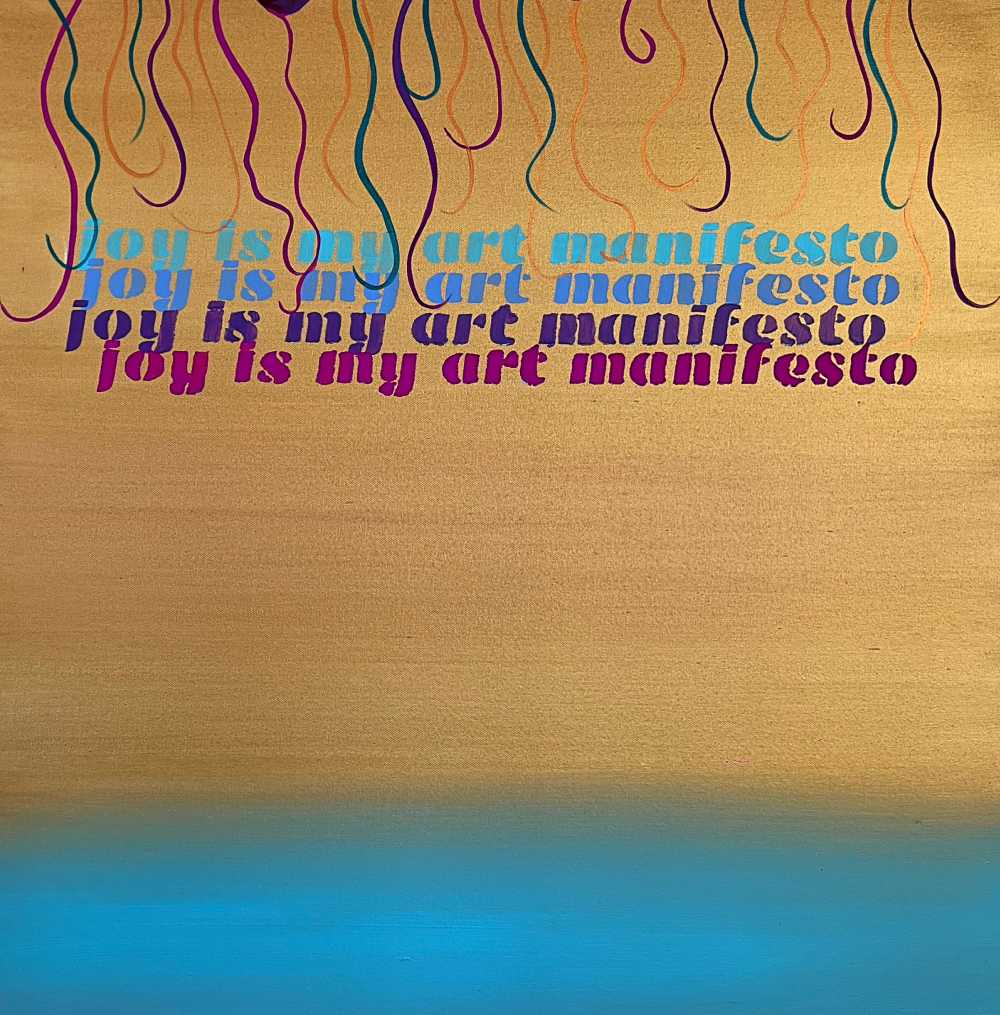
Joy Is My Art Manifesto by Rosana Auqué — a vibrant declaration of joy as presence, vision, and the emotional core of her artistic language
Joy Is My Art Manifesto
Artist: Rosana Auqué
Year: 2023
Medium: Acrylic on canvas
Dimensions: 36 × 48 inches
Price: USD $5,000
Inquiry
There are moments in an artist’s journey when a single word becomes more than language—it becomes direction. Joy Is My Art Manifesto emerges from that moment. In this painting, joy is not simply an emotion or a theme; it is a decision, a structure, and ultimately a way of seeing the world.
Created in 2023, this work marks a turning point in the practice of Rosana Auqué. The use of text becomes essential—not as decoration, but as presence. The word “JOY” appears with clarity and intention, carrying the weight of something both simple and absolute. It does not ask to be interpreted; it asks to be recognized.
The composition reflects this same idea. Color expands without hesitation, creating a sense of openness that feels immediate and alive. There is no tension in the gesture, no conflict in the space. Instead, everything seems to exist in agreement, as if the painting itself had accepted a truth before being made.
Joy here is not naive. It is not dependent on circumstances. It is closer to a quiet certainty—the kind that exists underneath noise, underneath doubt. The work suggests that joy is not something to be found, but something that has always been present, waiting to be acknowledged.
The Origin of the Balloon and the Language of Joy
This piece is also significant within Rosana Auqué’s broader visual language. It represents one of the early moments where the balloon begins to appear—not only as a recurring symbol, but as a structural element of meaning.
The balloon, in this context, is not decorative. It becomes a carrier of intention. Light, floating, and yet anchored in presence, it reflects the paradox that defines joy: something that feels weightless, yet deeply rooted.
A Word That Becomes Structure
The word “JOY” is reduced to its simplest form—three letters—yet it holds an expansive conceptual space. Its presence transforms the painting into something closer to a statement than a scene.
This is why the work can be understood as a manifesto. Not in the traditional sense of explanation, but as a declaration. A position taken without argument.
Joy as a Way of Seeing
Rather than describing a moment, the painting proposes a perspective. It suggests that reality itself may be filtered through the choice of joy. Not as denial, but as awareness.
There is an implicit idea running through the work: that protection, meaning, and coherence have always been there. The only shift required is recognition.
Material Presence and Scale
Executed in acrylic on canvas, the work maintains a balance between control and spontaneity. The 30 x 30 inch format reinforces its directness—large enough to hold presence, yet intimate enough to feel immediate.
The surface carries movement without fragmentation. Each gesture contributes to a unified field, where color and text coexist without hierarchy.
A Manifesto Without Explanation
Unlike traditional artistic manifestos, which rely on written articulation, Joy Is My Art Manifesto exists entirely through visual language.
It does not explain what joy is. It does not define it. Instead, it positions the viewer in front of it, as something already known.
There is no instruction, no conclusion. Only an invitation: to recognize that perhaps joy is not the result of life, but its starting point.
Frequently Asked Questions about “Joy Is My Art Manifesto”
What does “Joy Is My Art Manifesto” represent in Rosana Auqué’s work?
It represents a foundational statement within her artistic practice, where joy becomes both a conceptual axis and a lived perspective rather than a thematic element.
Why is the word “JOY” central in the painting?
Because it condenses a complex philosophical position into a direct visual presence. It functions as both message and structure.
How does this artwork relate to the use of balloons in her work?
This piece marks an early moment in which the balloon emerges as a symbol of lightness, intention, and emotional elevation within her visual language.
Is this artwork part of a larger conceptual series?
Yes, it connects with a broader exploration of language, emotion, and symbolic forms that appear across multiple works created during this period.
What makes this painting a “manifesto”?
It declares a position without explanation. The painting itself becomes the statement, removing the need for theoretical justification.