
How Do You Paint God?
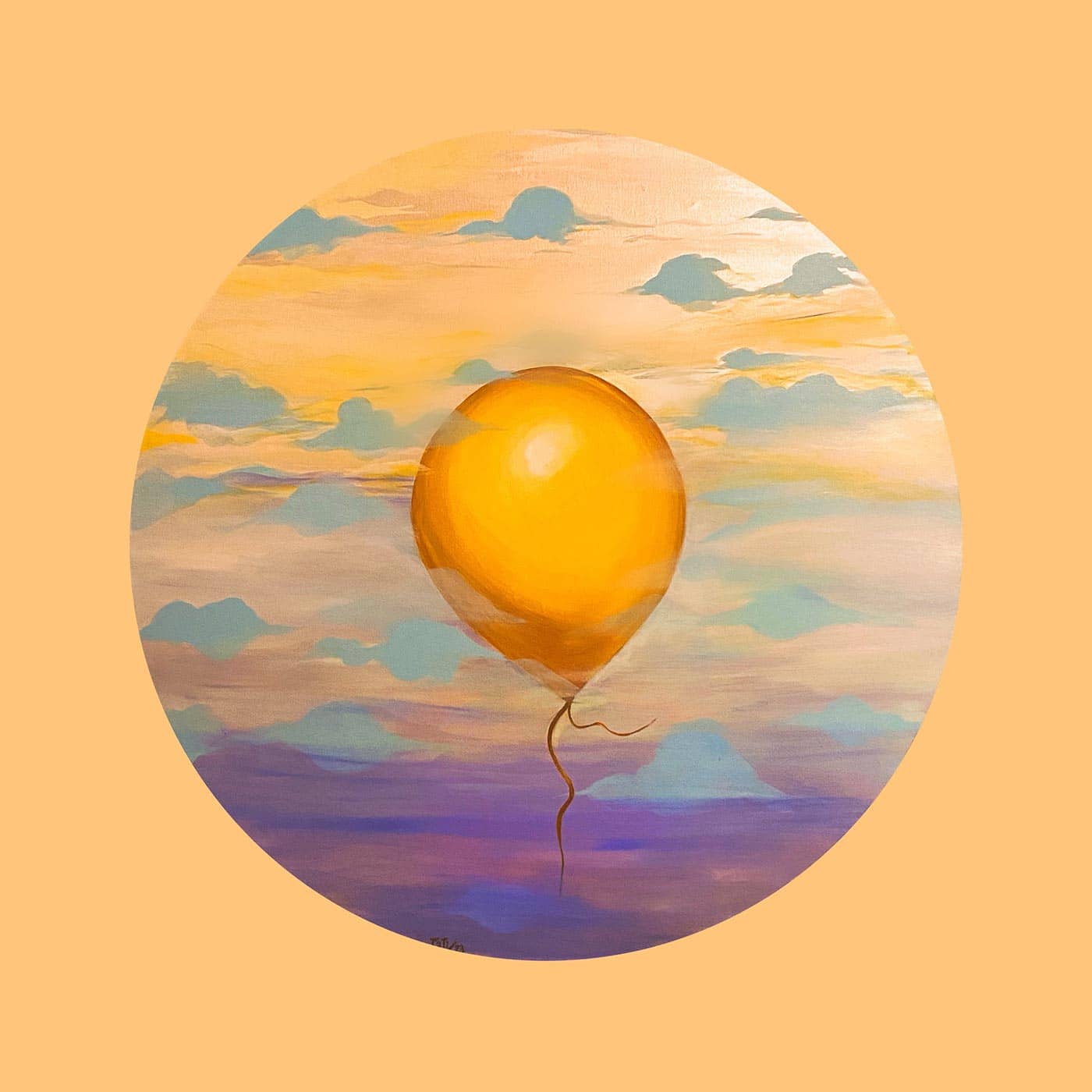
How do you paint God? It is a question that borders on impossibility. For centuries, artists have attempted to depict the divine through symbols, gestures, light, or narrative scenes. Yet every representation inevitably feels incomplete. God cannot be reduced to a face, a body, or a defined form.
In this work, Rosana Auqué does not attempt to portray a figure. Instead, she approaches the idea of God as energy — as origin. The painting becomes an exploration of the invisible force that sustains everything.
Rather than illustrating a doctrine, the artist dares to suggest presence.
At the center of the circular canvas, light emerges. Not as decoration, but as source. A radiance that expands outward, dissolving boundaries between matter and spirit. The form is not anthropomorphic; it is luminous. A silent core that appears to observe from above — not with judgment, but with awareness.
To paint God is not to define Him. It is to approach the unapproachable.
Light as the Primary Force of the Universe
In God, light is not an effect. It is structure.
The circular format reinforces the idea of totality — no beginning, no end. The diameter of 90 cm creates a contained universe, a symbolic cosmos in which illumination radiates from the center outward. The composition invites the viewer into a vertical relationship: something above, something beyond.
The work suggests that creation begins with light. Not a physical sun, but a metaphysical center — a primary force that precedes language and form. The surface carries movement, depth, and subtle transitions that evoke both expansion and containment.
This is not a narrative painting. It is contemplative.
Standing before it, one does not “understand” God. One feels watched, held within a larger field of existence.
The Circular Canvas as Symbol
The circular canvas is essential. Unlike a rectangle, it does not frame reality in horizontal or vertical terms. It removes hierarchy. It echoes planetary forms, halos, celestial bodies — yet remains abstract.
The circle becomes a metaphor for eternity.
In this sense, God aligns with Rosana Auqué’s broader exploration of universal forces — air, light, energy, and transformation — recurring themes throughout her artistic practice.
Spiritual Abstraction in Contemporary Art
This painting situates itself within a lineage of spiritual abstraction, yet it remains deeply personal. There is no iconography borrowed from religious traditions. No crosses, no clouds, no hands reaching from the sky.
Instead, the divine appears as presence through light.
The choice of acrylic on canvas allows the layering of luminosity and transparency. The surface does not feel heavy. It vibrates gently, creating an atmospheric quality that changes depending on distance and light conditions in the room.
The work does not impose belief. It opens a question.
Can the creator be felt rather than seen?
A Work of Contemplation and Interior Silence
God (2022) invites slowness. It is not a painting to pass by quickly. It requires pause.
Collectors who engage with this piece often describe a sense of calm confrontation — a paradoxical feeling of both intimacy and vastness. The central light becomes a point of return, a visual meditation.
This work is part of Rosana Auqué’s ongoing investigation into transcendence, perception, and the unseen structures that govern existence.
To paint God may be impossible.
But to suggest the divine through light — that is an artistic act of courage.
Artwork Details
Title: God
Year: 2022
Medium: Acrylic on canvas
Format: Circular
Diameter: 90 cm
Price: USD 8,000
Availability: Please inquire for current status
FAQs about the artwork God
What does the painting God represent?
The painting represents the idea of God as light and primary universal force rather than as a human figure. It explores divine presence through abstraction and luminous energy.
Why is the canvas circular?
The circular format symbolizes eternity, unity, and totality. It reinforces the idea of an infinite, beginningless and endless source.
Is God a religious painting?
It is spiritual rather than doctrinal. The work does not depict a specific religion but reflects on the concept of a universal creator through abstraction.
Is the artwork available for collectors?
Availability may change. Direct inquiry is recommended for updated information regarding acquisition.
