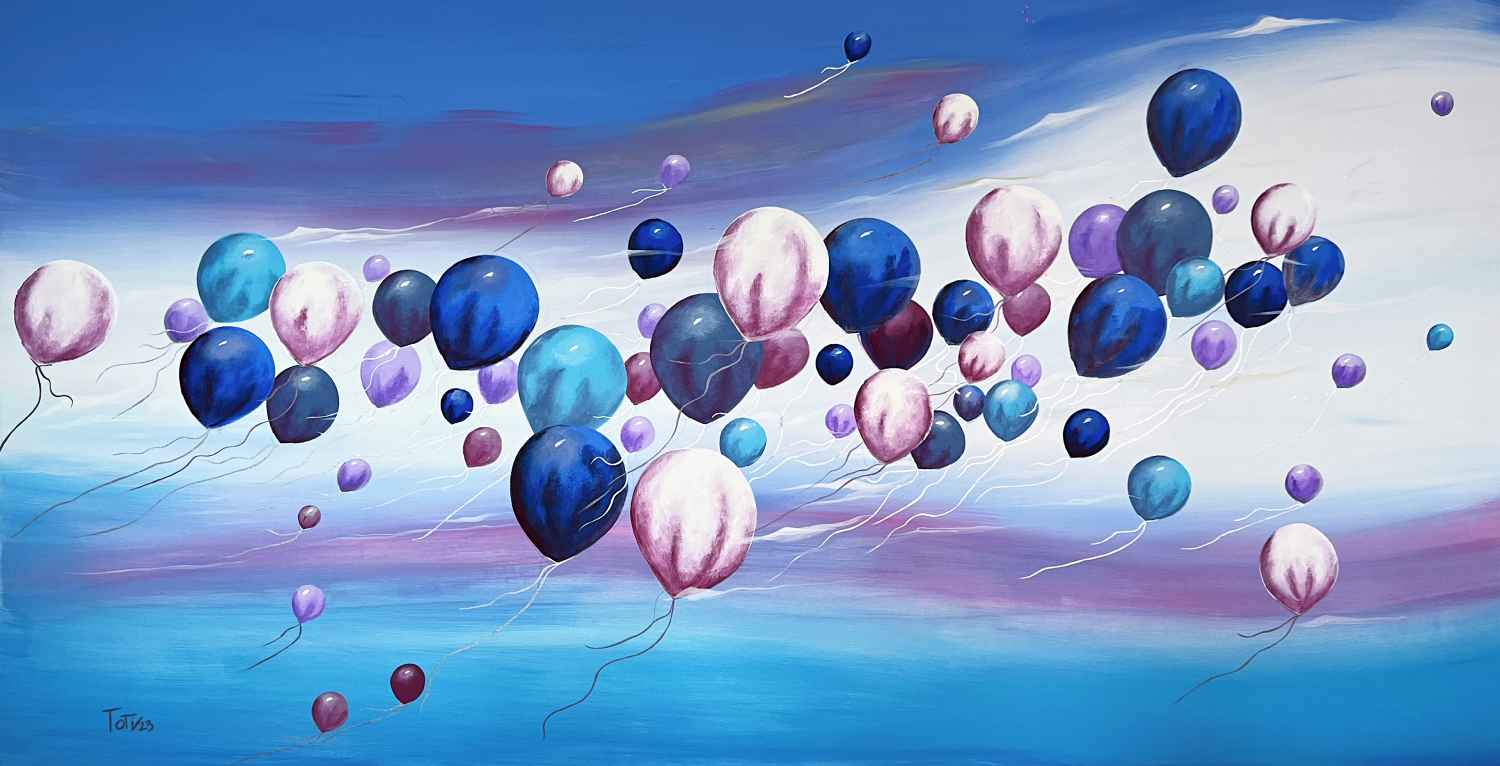
Forms of Love is a 2023 large-scale acrylic painting by Rosana Auqué that explores love as a shared field of presence, connection, and emotional energy through an expansive composition of layered balloon forms.
Forms of Love
Artist: Rosana Auqué
Year: 2023
Medium: Acrylic on canvas
Dimensions: 130 x 270 cm
Price: USD $17,000
Inquiry
Forms of Love — A Large-Scale Exploration of Emotional Energy
“Forms of Love” is a monumental work by Rosana Auqué that approaches love not as a singular feeling, but as a field of multiple presences. Spanning 130 x 270 cm, the painting unfolds horizontally, inviting the viewer into an expansive visual experience where emotion is not contained, but distributed.
At first glance, the composition appears dynamic and almost playful, filled with an abundance of balloon-like forms. Yet, beneath this apparent lightness lies a deeper intention: each element exists as an individual unit, carrying its own emotional charge, while simultaneously belonging to a larger system of connection.
This is not a painting about representation. It is a painting about transmission.
The Language of Multiplicity
Beyond Symbolism
In this work, the balloon is not used as a decorative or symbolic motif. It becomes a structural device — a way of organizing space, rhythm, and movement.
Each form holds a distinct presence, suggesting that love does not operate as a uniform force, but rather as a constellation of experiences: intimate, distant, fragile, expansive. The repetition of these elements does not create redundancy, but variation.
There is no central figure. No hierarchy.
Instead, the painting proposes a decentralized emotional landscape.
Density as Intention
“Forms of Love” is the most densely composed work within this line of exploration. The accumulation of forms is deliberate, not excessive.
The artist’s process — which extended over several months — reflects a gradual construction of balance. What initially appears as abundance becomes, over time, a controlled distribution of energy.
This density suggests a key idea:
There is no such thing as “too much” when it comes to love.
The painting resists minimalism. It embraces saturation.
A Spatial Experience of Love
Unlike smaller works, the scale of “Forms of Love” transforms the viewer’s relationship to the piece. It is not observed from a distance; it is entered.
The horizontal expansion allows the eye to move continuously, without interruption. There is no fixed starting point, no defined conclusion. The composition behaves more like a field than an image.
This spatial openness reinforces the conceptual foundation of the work:
Love is not static. It moves, accumulates, disperses.
Process and Time
A Work Built Over Months
The creation of this piece required sustained attention. Over time, the painting evolved through layers — not only of color, but of decisions.
Each addition altered the overall balance, requiring constant recalibration.
This temporal dimension is embedded in the final work. It is visible in the rhythm, in the distribution of forms, and in the sense of continuity that runs across the surface.
From Gesture to System
What begins as an intuitive gesture gradually becomes a structured composition.
The painting reflects this transition: from spontaneity to intention, from isolated marks to an interconnected system.
This duality — between intuition and control — is central to the artist’s practice.
Emotional Transmission and Viewer Experience
“Forms of Love” is conceived as an offering.
The idea that each viewer receives a “balloon” — a unit of love or hope — is not literal, but experiential. The work creates a space where emotional projection becomes possible.
There is no imposed narrative.
Instead, the painting allows each viewer to locate themselves within it.
Frequently Asked Questions about “Forms of Love”
What is the main idea behind “Forms of Love”?
The painting explores love as a multiplicity rather than a single emotion. It presents love as a network of individual yet interconnected presences.
Why are there so many balloon-like forms in the composition?
The repetition is intentional. Each form represents a distinct emotional unit, contributing to a broader field of energy and connection.
How long did it take to create this artwork?
The work was developed over several months, reflecting a process of gradual construction and balance.
Is the painting symbolic or abstract?
While it may suggest symbolic readings, the work operates primarily as an abstract system of forms and relationships rather than direct representation.
What role does scale play in this piece?
The large format transforms the viewing experience, allowing the observer to engage with the painting as an immersive spatial field rather than a contained image.
Is “Forms of Love” available for acquisition?
Yes, the artwork is part of Rosana Auqué’s available body of work. For acquisition inquiries, collectors can contact through the official website.