
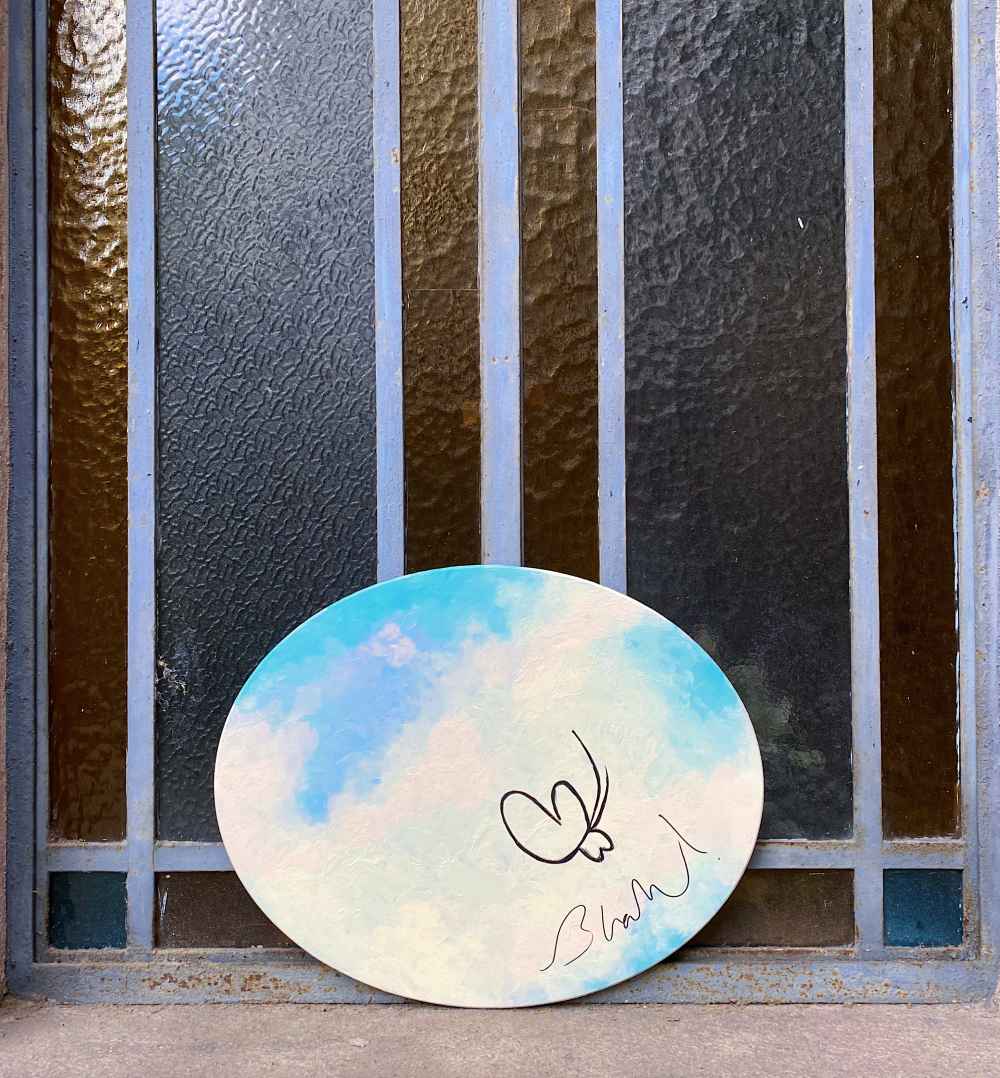
Blah by Rosana Auqué is an abstract oval painting that reflects inner noise, contradiction, and the search for personal truth.
Blah — An exploration of inner noise and personal truth
“Blah” is an acrylic on canvas work created in 2023 that moves within a space of contradiction, saturation, and internal dialogue. Its oval format subtly shifts the viewer’s perception, breaking away from rigid structures and introducing a more organic, continuous field of experience.
Rather than presenting a fixed narrative, the work unfolds as a reflection of the mental and emotional noise that surrounds contemporary life. Thoughts overlap, advice accumulates, and opposing directions coexist without resolution. Within this tension, the painting does not attempt to organize or clarify — it allows the density of experience to remain visible.
The oval shape reinforces this idea. Without clear edges or directional hierarchy, the composition suggests continuity rather than conclusion. There is no defined beginning or end, only a flow that mirrors the way thoughts emerge, collide, and dissolve.
At its core, “Blah” is not about confusion as a problem to solve, but as a condition to inhabit. It invites a pause — not to eliminate the noise, but to recognize it, and within it, identify what remains true.
Material and visual structure
Acrylic as a language of immediacy
The use of acrylic on canvas allows for a direct and responsive process. Layers can be built quickly, interrupted, or reworked, mirroring the fragmented rhythm of thought itself.
The surface carries traces of decision and revision. Rather than hiding these marks, the work integrates them, creating a visual field where movement and hesitation coexist.
The oval format as a conceptual gesture
The oval is not a decorative choice. It alters the relationship between viewer and image.
Without corners or linear boundaries, the composition resists containment. The viewer is not positioned in front of an object, but within a visual environment that extends beyond its limits.
This format reinforces the idea of continuity — a mental space where thoughts do not stop, but circulate.
A position within Rosana Auqué’s practice
Within the broader work of Rosana Auqué, “Blah” can be understood as a moment where the focus shifts inward.
While other works explore connection, expansion, or spatial relationships, this piece remains closer to the internal landscape. It addresses the tension between external influence and personal intuition — a recurring question within her practice.
The phrase embedded in the conceptual origin of the work — “wake up and do whatever is true to yourself” — is not presented as a message, but as a point of friction. It exists within a field of competing voices, making its presence more fragile and more necessary.
Interpretation — Between noise and clarity
The accumulation of voices
“Blah” captures a familiar condition: the saturation of opinions, expectations, and contradictions.
The painting does not filter these voices. Instead, it allows them to coexist, creating a sense of density that the viewer must navigate.
The act of choosing
Within this accumulation, the work introduces a subtle shift — the possibility of choosing what feels true.
This is not represented visually as a clear focal point. It emerges through the act of looking, as the viewer moves through the composition and begins to distinguish presence from noise.
Frequently Asked Questions about “Blah”
What is the main concept behind “Blah”?
The work explores the accumulation of thoughts, advice, and contradictions in the mind, and the challenge of identifying what remains personally true within that noise.
Why is the painting oval instead of rectangular?
The oval format removes directional hierarchy and creates a sense of continuity, reflecting how thoughts flow without clear boundaries.
How does this work relate to Rosana Auqué’s overall practice?
It represents a more introspective moment within her work, focusing on internal dialogue rather than external relationships or spatial expansion.
What role does the phrase behind the work play?
It introduces a tension between external influence and personal truth, but it is not imposed as a message — it exists as one voice among many.
Is the work part of a larger series?
While it connects conceptually with themes present in her broader practice, it functions as an independent piece focused on internal perception.