
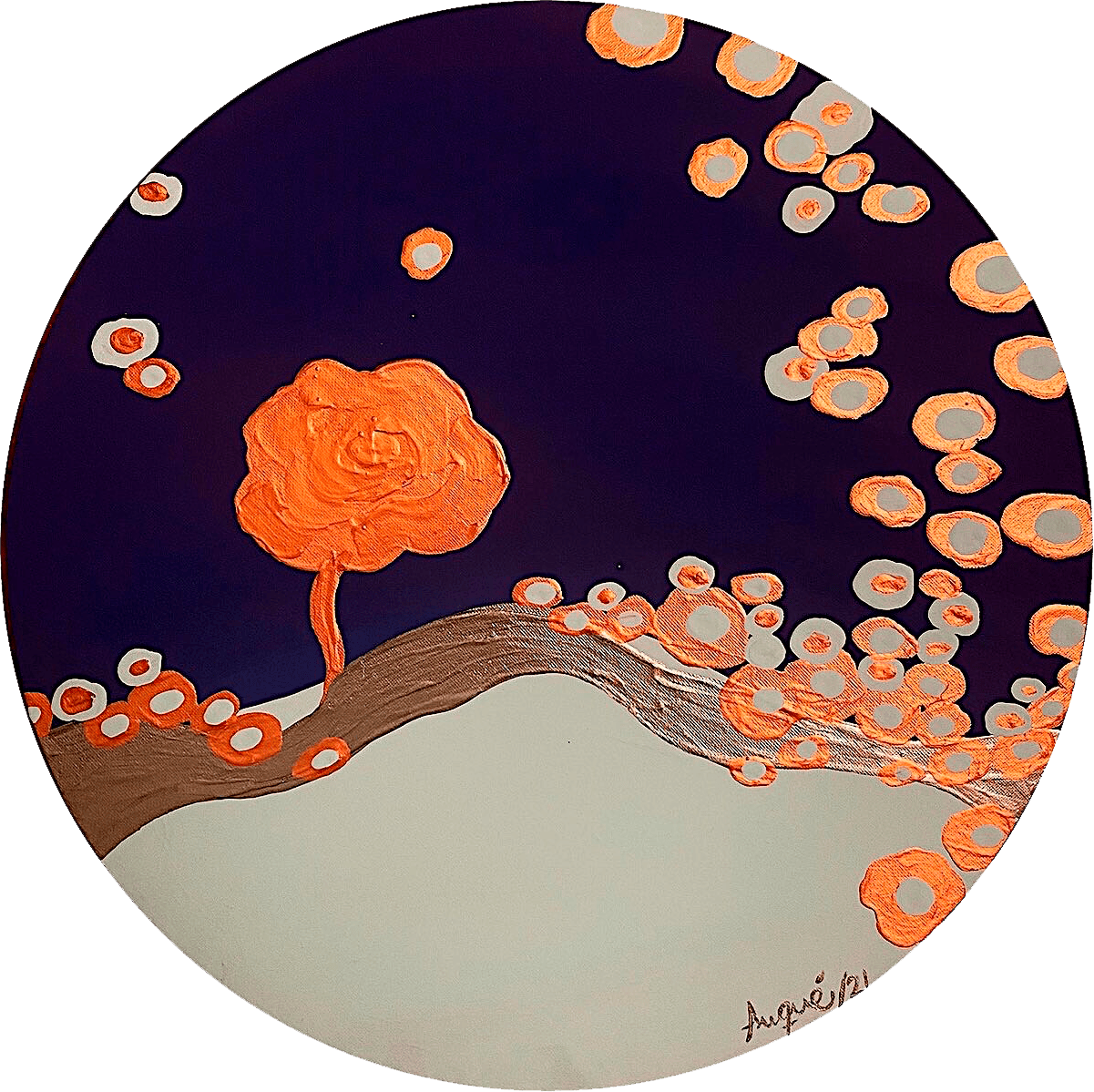
A suspended landscape where life adapts beyond gravity, transforming space into a place of possibility, resilience, and quiet beauty.
Zinnia
Year: 2021
Medium: Acrylic on canvas
Diameter: 50 cm
Private collection in Spain
Zinnia – A Landscape in Space
“Zinnia” (2021) is a circular acrylic and gold painting on canvas, measuring 50 cm in diameter. The work takes its name from the first flower successfully cultivated in space, grown aboard the International Space Station by astronaut Scott Kelly. More than a botanical reference, the title opens a symbolic field: life suspended in weightlessness, color unfolding beyond gravity, beauty surviving in the most improbable conditions.
This is not a representation of outer space in a literal sense. It is a landscape imagined from within it. A silent horizon where sky and void merge, where petals seem to float rather than grow, and where gold interrupts the infinite with warmth. The painting suggests that even in environments defined by technical precision and scientific control, fragility and poetry remain possible.
Rosana Auqué transforms the story of that first space-grown flower into a meditation on resilience, expansion, and human curiosity. “Zinnia” becomes a visual reflection on what it means to cultivate life where there is no soil, to imagine color where there is only darkness, and to insist on beauty in places designed for survival.
Material and Form
Acrylic and Gold on Canvas
The use of acrylic allows for luminous saturation and layered transparency. Gold introduces a subtle vibration that changes with light and distance. Rather than functioning as ornament, the gold elements operate as points of energy, echoing distant stars or solar fragments suspended in depth.
The circular format reinforces the idea of orbit and continuity. Without corners, the composition feels unbounded. The viewer does not enter a framed scene; instead, the eye rotates, drifts, and returns. The 50 cm diameter becomes a contained universe — intimate in scale, expansive in sensation.
The Zinnia as Symbol
The First Flower in Space
The historical reference to the zinnia grown in space is not anecdotal. It represents a turning point in how humanity relates to exploration. Cultivating a flower is different from launching a satellite. It implies care, time, patience, and attention — qualities that are rarely associated with space travel.
In this painting, the zinnia is both botanical and metaphorical. It stands for adaptability. It evokes the idea that life does not simply survive in new environments; it transforms them. The flower becomes a quiet protagonist in the vast narrative of space, suggesting that exploration is not only technological but also emotional and aesthetic.
A Contemporary Reflection on Expansion
“Zinnia” belongs to Rosana Auqué’s broader artistic exploration of sky, light, and elevation. However, it is not an extension of any previous work. Here, the sky is no longer terrestrial. It is cosmic. The sense of openness does not point upward from earth but outward into space.
The painting invites reflection on contemporary existence. We live in an era defined by rapid technological advancement and renewed interest in space exploration. Yet the emotional dimension of these achievements often remains unaddressed. “Zinnia” reintroduces intimacy into the narrative of expansion. It reminds us that beyond data and distance, there is still the human need for beauty.
Viewing Experience
Light, Distance, and Perception
The presence of gold alters the painting depending on lighting conditions. Under natural light, the surface appears warm and radiant. In softer environments, the gold recedes, allowing the acrylic layers to dominate. This variability reinforces the theme of shifting perspective — much like the experience of observing Earth from orbit.
The circular form encourages slow contemplation. There is no obvious beginning or end. The gaze moves fluidly, mirroring the sensation of weightlessness suggested by the subject.
Conceptual Questions
“Zinnia” quietly poses essential questions:
What does it mean to cultivate beauty beyond Earth?
Can fragility exist within systems designed for endurance?
How does the idea of landscape change when gravity disappears?
Rather than providing answers, the painting creates space for reflection. It offers a poetic interpretation of scientific history and reframes it as an emotional event.
Artwork Details
Title: Zinnia
Year: 2021
Medium: Acrylic and gold on canvas
Diameter: 50 cm
Format: Circular painting
Artist: Rosana Auqué
FAQs about Zinnia
What is the meaning of the painting “Zinnia” by Rosana Auqué?
“Zinnia” reflects on the first flower cultivated in space and explores themes of resilience, beauty, and expansion beyond Earth. It transforms a historical scientific milestone into a poetic meditation on life in extreme environments.
What materials were used in “Zinnia”?
The painting is created with acrylic and gold on canvas, measuring 50 cm in diameter.
Why is the painting circular?
The circular format reinforces ideas of orbit, continuity, and infinity. It eliminates hierarchical composition and invites rotational viewing.
Is “Zinnia” part of a specific artistic series?
While aligned with Rosana Auqué’s broader exploration of sky and elevation, “Zinnia” stands conceptually on its own as a reflection on space and cultivation beyond Earth.