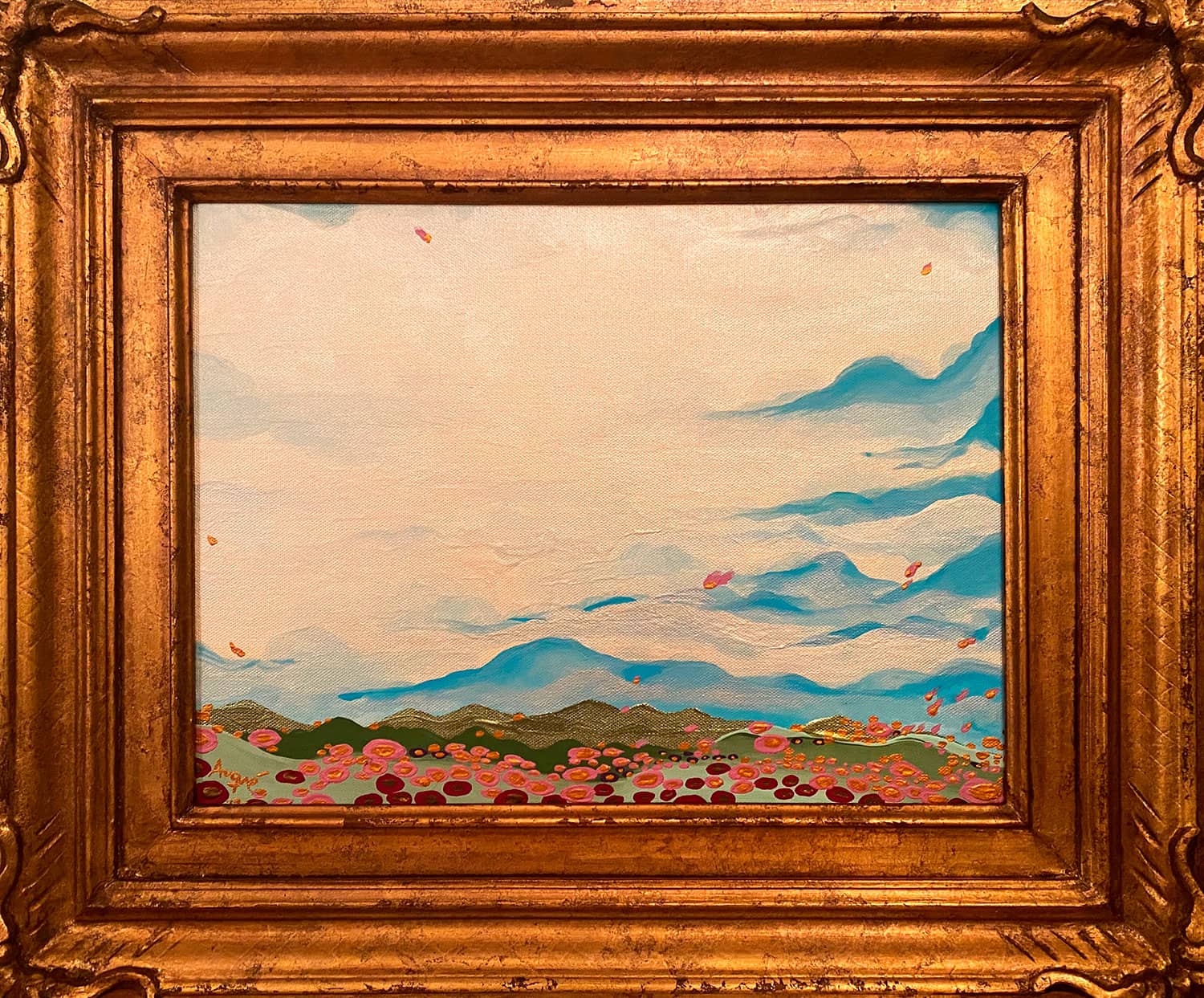
A quiet alignment where movement becomes trust, allowing unseen forces to shape balance across time and presence.
El Viento
Year: 2022
Medium: Oil on canvas
Dimensions: 40 × 30 Cms
Private collection in Italy
Artwork in an antique frame from the 1800s.
About the Artwork
El Viento is a meditation on movement, trust, and suspended harmony.
This painting was conceived around a frame discovered in a flea market in Milan — an antique piece from circa 1800. Rather than adapting the frame to a pre-existing work, the painting was created specifically for it. The frame became the origin point, not the decoration.
The gesture reverses chronology: a contemporary work inhabiting a historical structure. Past and present meet in a moment that feels both fragile and inevitable.
The piece explores the instant when wind moves flowers and clouds into a perfect alignment — a fleeting second where chaos becomes harmony. That second is not dramatic. It is subtle. It exists quietly before dissolving again.
In El Viento, that ephemeral alignment is preserved.
Concept: Trusting the Wind
The central idea behind this work is simple yet profound:
the world is a place to trust and believe in — and to flow like the wind.
Wind does not force. It moves without resistance. It transforms landscapes without ownership. It passes through rather than dominating.
In this painting, movement is not represented as turbulence but as balance. Flowers respond to air. Clouds reorganize themselves. The elements do not struggle — they collaborate.
This collaboration becomes a metaphor for faith in life’s invisible currents.
Unlike works that dramatize nature, El Viento portrays wind as a quiet intelligence — an unseen force that connects rather than disrupts.
Materials and Surface Language
The use of gold, bronze, and acrylic introduces a layered material dialogue.
Gold suggests illumination and inner light.
Bronze introduces warmth and density.
Acrylic allows fluid gesture and chromatic transparency.
Metallic pigments are not ornamental here. They react to light. Depending on the viewing angle, the surface shifts subtly, echoing the movement of air itself.
The painting does not remain static. It breathes with the room.
The modest scale (40 × 30 cm) invites intimacy. It requires proximity. The viewer must come close, just as one feels wind on skin rather than observing it from afar.
The Antique Frame: A Temporal Dialogue
The antique frame from the 1800s is not incidental.
Its historical presence adds a temporal depth to the work. It carries traces of previous centuries — hands, interiors, stories unknown. By creating a painting specifically for this frame, the work becomes a dialogue across time.
The contemporary gesture of gold and acrylic meets aged wood and carved ornament.
This meeting is not nostalgic. It is structural.
The frame does not contain the painting; it participates in it.
In this sense, El Viento becomes both object and conversation.
Provenance and Collector Context
El Viento is now part of a private collection in Italy.
Its journey — from a Milan flea market to a collector’s home — mirrors its conceptual narrative: discovery, trust, movement.
The work holds personal significance within Rosana Auqué’s practice. It represents a moment of alignment between material intuition and emotional clarity.
Artwork Details
Title: El Viento
Artist: Rosana Auqué
Year: 2022
Medium: Gold, bronze, and acrylic on canvas
Dimensions: 40 × 30 cm
Frame: Antique wooden frame, circa 1800
Status: Private collection, Italy
Frequently Asked Questions
What does “El Viento” represent in Rosana Auqué’s work?
El Viento represents trust in invisible forces — the idea that movement and harmony can coexist without conflict. It explores how fleeting natural alignments can be emotionally permanent when captured in art.
Why is the antique frame important to the artwork?
The frame predates the painting by over a century. The work was created specifically for this historical object, establishing a dialogue between contemporary expression and inherited structure.
What materials are used in “El Viento”?
The painting combines gold, bronze, and acrylic on canvas. Metallic elements create subtle reflective variations that change depending on light and viewing angle.
Where is “El Viento” located today?
The artwork is part of a private collection in Italy.
How does this work relate to Rosana Auqué’s broader practice?
Like many of her paintings, El Viento explores harmony, emotional suspension, and the poetic tension between movement and stillness. It reflects her interest in preserving ephemeral beauty within structured form.