The Origin of The World
Artist: Rosana Auqué
Year: 2023
Medium: Acrylic on canvas
Dimensions: 50 x 30 cm
Price: USD $2,500
Inquiry
The Origin of The World – A Painting About Beginnings
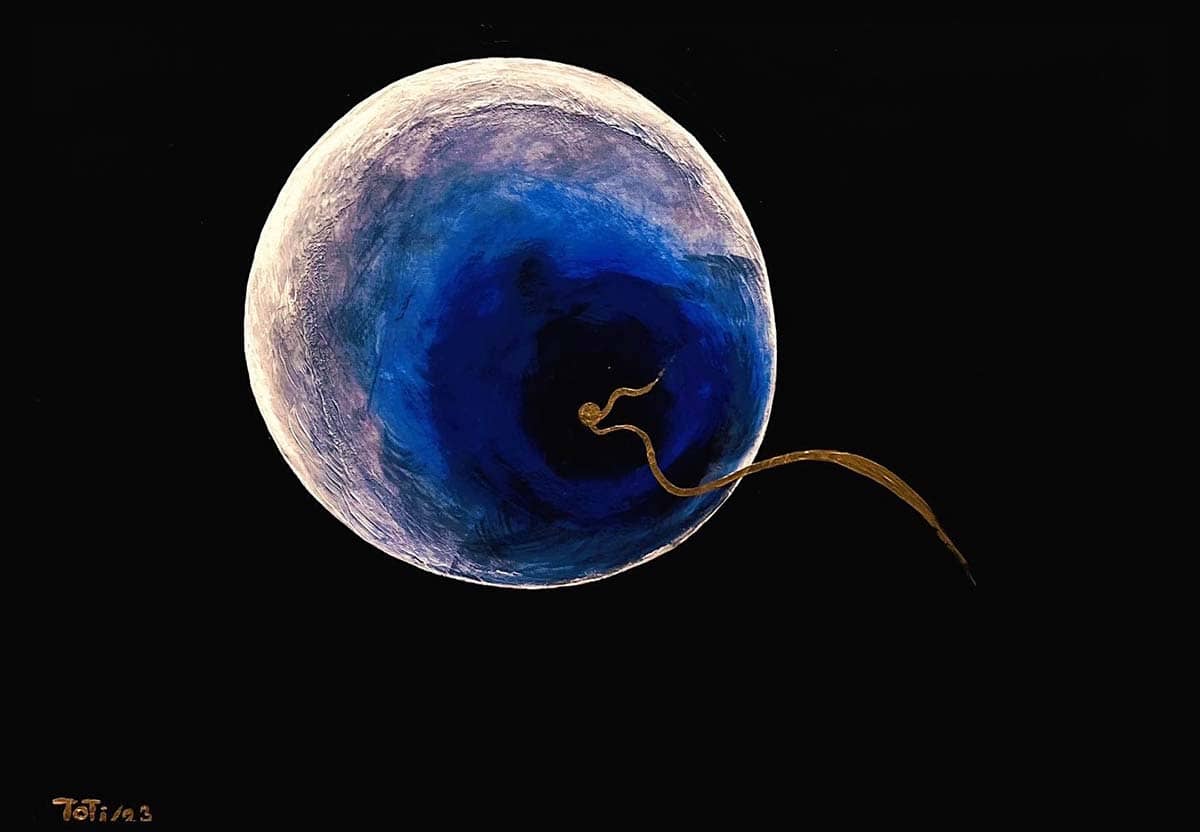
The Origin of The World is a work that marks a subtle yet meaningful shift within Rosana Auqué’s visual language. Created in 2023, this painting introduces a new perspective—literally and conceptually—by presenting, for the first time, a balloon seen from above. This change in viewpoint transforms a familiar symbol into something more ambiguous, more open, and ultimately more essential.
The balloon, a recurring element in Auqué’s work, is no longer simply an object of elevation or lightness. Here, it becomes something else: a form that suggests emergence. From this angle, it no longer floats—it unfolds.
The painting invites the viewer into a moment before definition, where form, color, and meaning are still becoming.
A Shift in Perspective
Seeing the Balloon Differently
In earlier works, the balloon often appears as a figure moving upward, associated with joy, expansion, or emotional release. In The Origin of The World, that narrative is suspended.
By painting the balloon from above, Auqué removes its directional movement. What remains is a circular presence—almost organic—resembling a cell, a nucleus, or a point of origin. The viewer is no longer looking at something that rises, but at something that begins.
This perspective creates a quiet tension: the image feels both intimate and infinite at the same time.
Color as Creation
Between the Microscopic and the Cosmic
The colors in this painting play a central role in its meaning. They are not applied to define objects, but to suggest states—vibrations that exist somewhere between the internal and the universal.
At times, the surface may evoke something biological, like the beginning of life at a microscopic level. At others, it opens outward, recalling planetary formations or distant galaxies. This dual reading is not accidental—it reflects a continuous relationship between the smallest and the largest scales of existence.
The painting does not choose between these interpretations. It allows both to coexist.
The Idea of Origin
A Beginning Without Narrative
The title, The Origin of The World, does not point to a specific story or reference. Instead, it frames the work as a space of reflection.
There is no clear beginning or end within the composition. No defined structure dictates how the image should be read. What exists is a field of possibility—an image that suggests the moment before something becomes recognizable.
In this sense, the painting is less about depicting the origin of the world and more about evoking the feeling of origin itself.
Material and Presence
A Physical Yet Open Surface
Executed in acrylic on canvas, the painting maintains a tactile quality that reinforces its immediacy. The dimensions (50 x 30 cm) create an intimate format, inviting close observation rather than distant viewing.
The surface does not impose itself; instead, it holds space. It allows the viewer to approach, to pause, and to interpret without urgency.
Frequently Asked Questions about “The Origin of The World”
What makes this painting different from other balloon works by Rosana Auqué?
This is the first time the balloon is represented from above, removing its sense of upward movement and transforming it into a symbol of origin rather than elevation.
What does the painting represent?
The work suggests the idea of beginnings—of life, of the universe, or of form itself—without defining a single interpretation.
Why is the perspective important?
The top view shifts the meaning of the balloon, turning it into something more abstract and organic, closer to a point of emergence.
Is there a specific reference behind the title?
The title is not tied to a specific narrative. It functions as a conceptual frame that invites reflection on the idea of origin.
How should the painting be experienced?
There is no fixed way to read the work. It is meant to be observed slowly, allowing different interpretations to appear over time.