
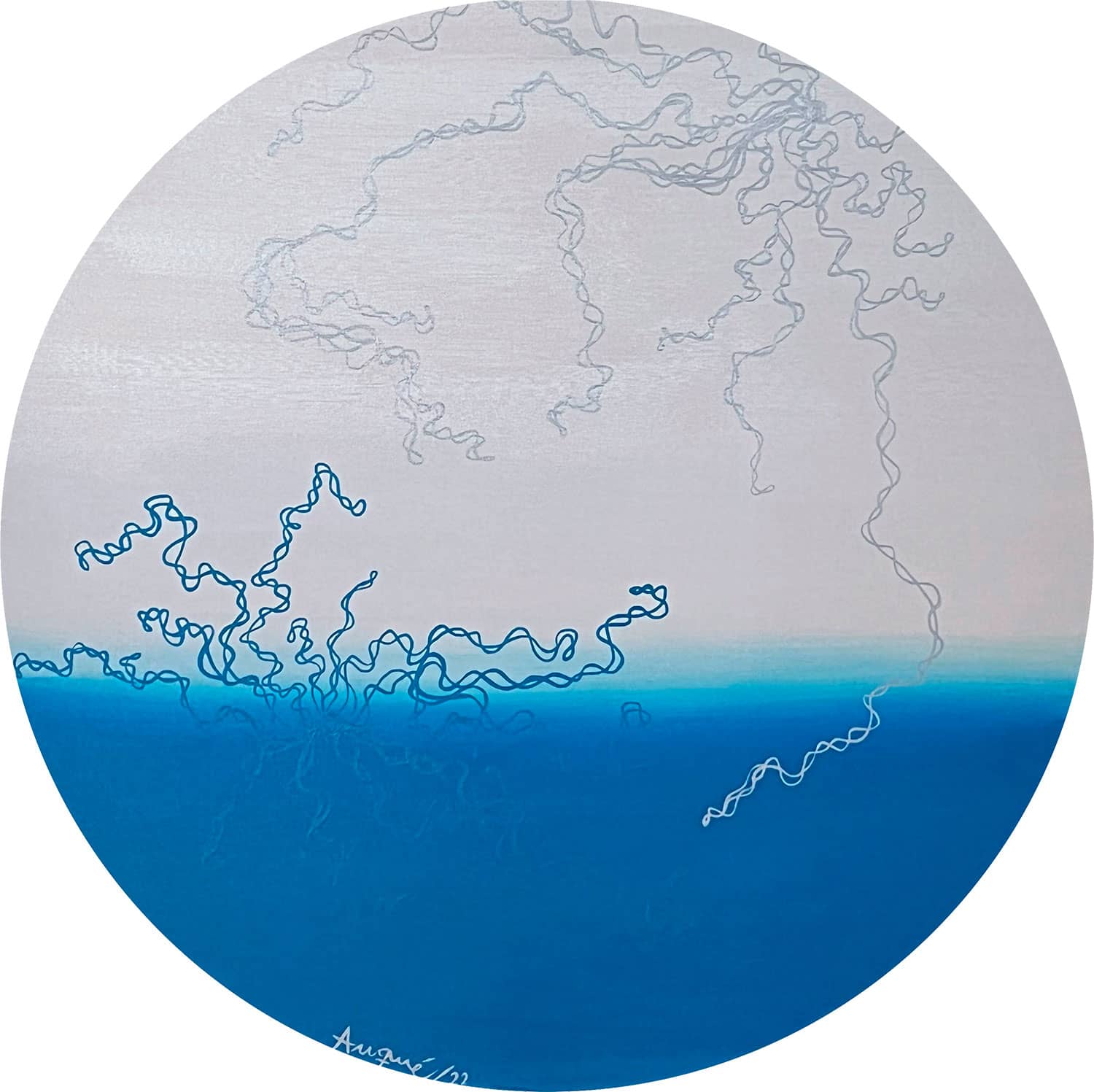
private collection in colombia
Santa Marta
Artist: Rosana Auqué
Year: 2022
Medium: Acrylic on canvas
Diameter: 100 cm
“Santa Marta” – A Field of Origin and Return
“Santa Marta” is not only a title; it is a place that exists both geographically and internally. In this painting, the gesture is not about representing a city, but about inhabiting it. The work unfolds as an energetic field where memory, presence, and connection dissolve into one continuous movement.
Created in 2022 as part of the Connection collection, this circular composition becomes a space without hierarchy. There is no beginning, no center that dominates, no fixed direction. Instead, everything flows. The painting invites the viewer to experience Santa Marta not as a location on a map, but as a living system of relationships—between color, movement, and the invisible threads that connect us.
The circular format reinforces this idea: what happens in one part of the canvas resonates across the whole. It is an ecosystem of energy, echoing the way life unfolds in constant interaction.
The Language of Energy and Belonging
At its core, “Santa Marta” speaks about belonging—not as possession, but as connection. The painting does not describe the city; it transmits its rhythm. Layers of acrylic expand and intertwine, suggesting movement that never fully stops, much like the ocean that surrounds the city itself.
A City Felt Rather Than Seen
Rather than depicting recognizable elements, the work captures sensation. The warmth, the openness, the continuity of life—all are translated into fluid transitions of color and form. The painting becomes a sensory memory, something that is felt before it is understood.
The Circle as a Living Structure
The 100 cm diameter format is not incidental. It removes edges, dissolves boundaries, and allows the viewer’s gaze to travel without interruption. This reinforces a key idea within the Connection collection: everything is part of the same system. Nothing exists in isolation.
Connection as a Way of Seeing
“Santa Marta” extends beyond personal memory into a broader reflection on how we exist within the world. The painting suggests that connection is not something we create—it is something we recognize.
The waves of energy moving across the canvas echo the invisible relationships that define life: between people, places, emotions, and time. In this sense, the work is not static. It is continuously unfolding, depending on how it is experienced.
This perspective aligns with the conceptual foundation of the Connection series, where each piece becomes a fragment of a larger, ongoing dialogue about existence, unity, and transformation.
Material Presence and Artistic Process
Executed in acrylic on canvas, the work maintains a balance between control and spontaneity. The layering process allows colors to interact freely, creating transitions that feel organic rather than imposed.
There is no attempt to dominate the material. Instead, the process becomes a collaboration between intention and emergence. The painting grows through interaction—just as the concept of connection itself.
Frequently Asked Questions about “Santa Marta”
What does “Santa Marta” represent in this artwork?
Rather than representing the city literally, the painting expresses the emotional and energetic experience of being connected to it. It reflects memory, presence, and a sense of belonging that goes beyond geography.
Why is the painting circular?
The circular format removes hierarchy and direction, allowing the viewer to experience the work as a continuous flow. It reflects the idea that everything is interconnected and part of the same system.
How does this piece relate to the Connection collection?
“Santa Marta” is a key expression of the Connection collection’s core idea: that life is a network of relationships and energies in constant movement. The painting visualizes this through fluid forms and layered interactions.
What techniques are used in this painting?
The work is created using acrylic on canvas, with layered applications that allow colors to merge and evolve organically. The technique emphasizes movement and interaction rather than fixed structure.
Is this painting tied to a specific moment or place?
While it originates from the artist’s hometown, the painting transcends a specific time or place. It becomes a universal reflection on connection, presence, and the shared experience of being part of something larger